Sociology Optional Online Module Course for UPSC: A Clear Guide to Paper I
- Dialectics IAS
- July 12, 2026
- 0 comment
Most Sociology Optional aspirants do not struggle because they lack material. They struggle because Paper I feels scattered — the discipline, the science debate, research methods, and six thinkers, all arriving at once, with no clear sense of where to begin.
This is exactly where a Sociology Optional online module course for UPSC becomes useful — not as a shortcut, but as a way to bring structure to a syllabus that otherwise feels like too much, too fast.
This guide explains what such a course actually involves, what a focused Paper I module typically covers, and how to judge whether this format suits your own preparation.
A Sociology Optional online module course is a structured, Paper I-focused programme — usually built around lectures, doubt-clearing sessions, and evaluated tests — that helps a student build conceptual clarity in the discipline, Sociology as Science, Research Methods, and the six major thinkers, without committing to a full-length coaching programme.
- A module course focuses on one part of the syllabus — typically Paper I — rather than the entire Sociology Optional syllabus.
- Paper I’s thinkers section carries considerable weight and shapes how well concepts transfer into Paper II answers.
- Conceptual clarity, not memorised model answers, is what UPSC evaluation actually rewards.
- Evaluation quality matters as much as lecture count — who reads your answer determines how useful the feedback is.
- A module course suits certain students well; it is not automatically the right choice for everyone.
What Does Sociology Optional Paper I Actually Cover?
Paper I is the theoretical half of Sociology Optional, worth 250 marks, and it rests on four broad areas.
Sociology as a discipline covers its emergence, scope, and relationship with other social sciences — the groundwork before anything else makes sense. Sociology as Science asks whether sociology can be studied scientifically at all, introducing positivism and its critics.
Research Methods and Analysis covers how sociologists actually study society — surveys, case studies, participant observation, and the qualitative-quantitative divide. And then come the six thinkers who anchor the paper: Karl Marx, Émile Durkheim, Max Weber, Talcott Parsons, Robert K. Merton, and G. H. Mead.
None of these sit in isolation. A student who understands Durkheim’s idea of social facts, for instance, reads Weber’s social action very differently — and both ideas resurface constantly in Paper II answers on Indian society.
This is worth understanding early, because it shapes how a module course should be evaluated: not simply by lecture count, but by whether it builds these connections deliberately.
What is a Sociology Optional Online Module Course?
A module course is simply a course built around one defined part of the syllabus, rather than the full two-paper programme. For Sociology Optional, this usually means a Paper I-focused course — lectures covering the discipline, the science debate, research methods, and the six thinkers, along with some form of doubt-clearing and evaluated testing.
This is different from a full course, which typically spans both Paper I and Paper II across several months. It is also different from buying disconnected notes or recorded videos with no structure holding them together. A module sits between these two options — enough structure to build real clarity, without the time and cost of a full programme.
Some students describe this format as a Sociology Optional Paper I foundation course, since it is meant to build the base the rest of preparation rests on, rather than covering everything at once.
What Should You Check Before Choosing Any Online Module Course?
Since “online course” has come to mean very different things across providers, it helps to ask a few direct questions before enrolling in any of them.
- Does the same person who teaches the concept also evaluate your answers, or is evaluation handed to someone else?
- Is feedback a genuine discussion about your answer, or a mark with a few lines in the margin?
- Is the batch size small enough for individual attention, or is it a large, one-size-fits-all cohort?
- Does admission involve any conversation about your preparation level, or is it a straightforward payment?
- Is the syllabus coverage focused and sequential, or does it jump between topics without clear structure?
None of these questions has a universally right answer, but they are worth asking of any Sociology Optional Paper I online classes you are considering, including this one.
Why Do Model Answers Cap Your Score?
Many students prepare Sociology Optional by collecting model answers and reproducing them with minor changes. This feels efficient, but it works against how UPSC actually evaluates Sociology Optional.
The examiner is reading hundreds of scripts on the same question. An answer built from a memorised template, however well-written, tends to look identical to dozens of others — flatten the individuality out of it, and there is little left to reward.
What UPSC responds to instead is a clear, original line of argument: a student’s own reading of Marx or Durkheim, applied to the specific demand of the question.
This is why conceptual clarity matters more than volume of notes. A module course that teaches you to think with a thinker, rather than recite them, is doing something a stack of model answers cannot.
Considering a Focused Paper I Course?
The Sociology Optional Paper I Online Course covers the discipline, Sociology as Science, Research Methods, and all six thinkers, with doubt-clearing sessions and sectional tests built in.
How Does a Module Course Differ from a Full Sociology Optional Course?
Aspect | Full Course | Module Course |
Scope | Paper I and Paper II | Usually Paper I only |
Duration | Several months | Shorter, focused period |
Best suited for | Students starting from zero on both papers | Students needing focused help on a specific stretch |
Depth per topic | Broader, sometimes less concentrated | Deeper focus on fewer topics |
Neither format is inherently better. A full course makes sense for someone who needs the entire syllabus built from the ground up. A module course makes sense for someone who already has some grounding, or who wants to address one part of the syllabus — often the thinkers — with real depth before deciding on the rest of their preparation.
What Would a Focused Paper I Module Typically Include?
A genuinely structured Paper I module tends to follow the syllabus logically, rather than jumping between topics. As an example, Dialectics IAS’s Sociology Optional Paper I Online Course runs across roughly 30 online lectures, covering:
- Sociology – The Discipline
- Sociology as Science
- Research Methods and Analysis
- The six major thinkers: Karl Marx, Émile Durkheim, Max Weber, Talcott Parsons, Robert K. Merton, and G. H. Mead
Two doubt-clearing sessions are built in, along with two sectional tests of 250 marks each, giving students a way to check whether their conceptual understanding is actually converting into answers.
Thinker | Core Focus |
Karl Marx | Class, conflict, and capitalism |
Émile Durkheim | Social facts, division of labour, anomie |
Max Weber | Social action, ideal types, bureaucracy |
Talcott Parsons | Structural functionalism |
Robert K. Merton | Middle-range theory, manifest and latent functions |
G. H. Mead | Symbolic interactionism, the self |
The thinkers section is often described as the operational engine of Paper I — get comfortable applying these six frameworks, and much of the rest of Paper I, and a fair amount of Paper II, becomes easier to write about with confidence.
Not Sure Which Approach Fits Your Preparation Stage?
A short conversation with a professor can help you see where you currently stand, before you commit to any course or format.
How is Learning Evaluated in a Module Course?
Lectures build understanding, but evaluation is where that understanding gets tested against actual UPSC-style writing. In a well-structured module, doubt-clearing sessions exist to resolve gaps before a test, and sectional tests exist to convert theory into answers under real conditions.
Who evaluates the answer matters. When the same person who taught the concept also reads the answer, feedback tends to be more specific — pointing not just to what is missing, but to why a particular line of argument does or doesn’t work. This is different from receiving a mark with brief, generic comments in the margin.
Who Should Choose a Focused Module Over a Full Course?
A module course tends to suit:
- Beginners who want to start Paper I with structure, before deciding on the rest of the syllabus
- Engineering, science, or commerce graduates encountering sociological thinking for the first time
- Working professionals who need a defined, time-bound starting point
- Repeat candidates who understand the theory broadly but need to sharpen how they apply it in answers
- Self-study candidates who want guided structure without a full-length commitment
Engineering and science graduates in particular often find the transition into argument-based, conceptual writing unfamiliar at first —Sociology Optional for engineers looks at this in more detail.
It may suit you less if you are starting both papers from zero and prefer one continuous programme covering the whole syllabus in one structure. Neither choice is wrong — it depends on where you currently stand.
Self-Study vs. Guided Module vs. Full Course
Approach | What It Offers | What It Demands |
Self-study | Full control over pace and material | Discipline, and no external evaluation |
Guided module | Structure plus evaluation on one focused area | Some cost, limited scope |
Full course | Complete syllabus coverage in one programme | More time and cost |
There is no universally correct answer here. A student with strong self-discipline and prior exposure to the subject may do well with self-study supported by occasional evaluation. A student encountering Sociology for the first time is often better served by structure, at least to begin with.
Frequently Asked Questions
Ans. It is a structured online course focused on one part of the syllabus — usually Paper I — covering the discipline, Sociology as Science, Research Methods, and the six major thinkers.
Ans. No. A module course typically covers Paper I. Paper II, which deals with Indian society, would need to be prepared separately.
Ans. A full course usually spans both papers over several months. A module course focuses on a defined part of the syllabus, in less time, with more concentrated attention on that area.
Ans. Karl Marx, Émile Durkheim, Max Weber, Talcott Parsons, Robert K. Merton, and G. H. Mead.
Ans. It can be, provided the course includes real interaction — doubt-clearing, evaluated tests, and feedback that goes beyond a mark and a few written comments.
Ans. Yes. A well-structured module builds from basic concepts, so a Sociology background is not a prerequisite.
Ans. Generally, yes, since these courses are usually less time-intensive than a full-length programme, though schedules do need to be discussed and confirmed directly.
Ans. A properly structured one does — through sectional tests that ask students to apply concepts under UPSC-style conditions.
Ans. Paper I tests theoretical understanding and its application; Paper II applies similar thinkers and concepts to Indian society specifically.
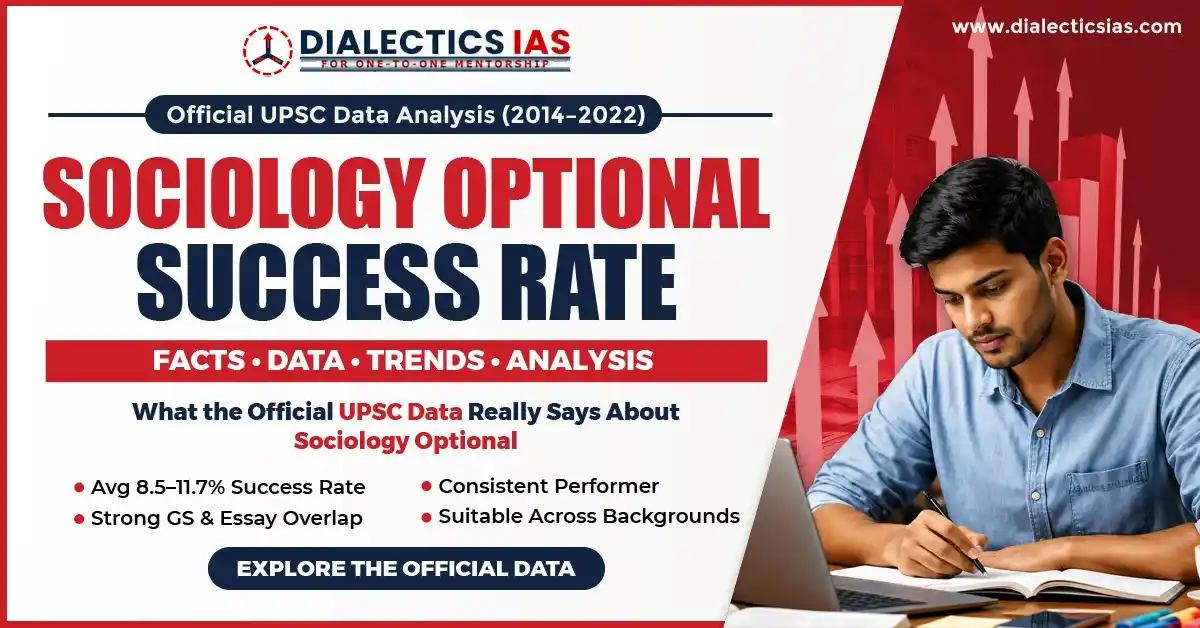
Ans. Based on UPSC Annual Reports, the recorded success rate for Sociology Optional has ranged between 8.5% and 11.7% across CSE 2014–2022.
Ans. This depends on your starting point. Beginners on both papers often prefer a full course; those needing focused help with Paper I, or with some existing grounding, often find a module course sufficient.
Ans. It is a commonly chosen optional among engineering and science graduates, though suitability depends on individual interest and comfort with conceptual, argument-based writing.
Conclusion: Build the Foundation Before You Build the Score
A Sociology Optional online module course for UPSC is not a shortcut, and it is not the only way to prepare. It is simply one honest option among several — well suited to a student who wants focused, evaluated clarity on Paper I, without committing to a full-length programme before they know what they actually need.
Whichever path you choose, the underlying goal stays the same: understanding the thinkers well enough to argue with them, not just describe them. That is what UPSC evaluation ultimately rewards, and it is worth building deliberately, whatever course structure gets you there.