Sociology Optional for Engineers: Strategy, Data, and What UPSC Results Actually Show
- Dialectics IAS
- May 27, 2026
- 0 comment
Let’s start with a number that surprises most people. According to UPSC Annual Reports, engineering graduates have consistently formed over 60% of finally recommended candidates in recent Civil Services exam cycles. That means if you look at the final merit list, more than half the people who made it — were engineers.
Now here is the part that almost no one talks about: very few of these engineers chose an engineering-related optional subject.
The large majority switched to humanities subjects and Sociology has consistently been among the most preferred choices among those subjects.
This is not random; it reflects a clear, logical pattern that serious aspirants need to understand before making their optional decision. This page examines that pattern honestly — and tells you exactly what it means for your preparation.
Why Most Engineers Do Not Choose Engineering-Related Optionals in UPSC
If you are from an engineering background, your first instinct might be — “Should I stick with my graduation subject?” Let’s think about this carefully.
Engineering-related optionals — Electrical, Mechanical, Civil, Computer Science, Mathematics — have one fundamental problem in the context of UPSC Mains: they do not connect with your other papers.
Here is what that means practically:
Paper | Does Engineering Optional Help? | Does Sociology Optional Help? |
GS Paper I (Indian Society) | No overlap | Direct 40–50 marks overlap |
GS Paper II (Social Justice, Governance) | Minimal | Strong conceptual support |
GS Paper IV (Ethics) | Very limited | Clear overlap with values and norms |
Essay Paper | No direct benefit | Regular thematic overlap |
Interview | Subject-specific only | Broader social perspective |
UPSC Mains rewards integrated preparation — where one subject strengthens multiple papers at the same time. Engineering optionals simply do not offer this. You put in full effort for returns in only one paper.
That structural problem, more than anything else, is what pushes serious engineering aspirants toward Sociology. Not because Sociology is easy — but because it is more efficient for the UPSC system as a whole.
Why Do Engineers Choose Sociology Optional? The Strategic Logic Behind the Data
This is the question every engineering-background aspirant eventually asks. The answer has three clear parts — and each one is grounded in either UPSC data or straightforward logic.
Reason 1 — The Way Engineers Think Already Works in Sociology
Your engineering training has built one specific habit of mind: breaking a complex system into its components, understanding how they interact, and building models that explain the whole.
Sociology works in exactly the same way — just applied to society instead of machines.
Sociological theories like structural functionalism, conflict theory, and symbolic interactionism are explanatory models. They are frameworks that explain how society functions, why it changes, and what forces shape human behaviour.
When you study Marx’s conflict theory or Durkheim’s structural functionalism, you are essentially learning a model — just like learning a circuit diagram or a thermodynamic cycle. Engineers can map these frameworks quickly because the logic of model-building is already familiar to them.
Reason 2 — The Syllabus Fits the Time You Have
Sociology Optional can be covered comfortably in four to six months with regular, focused study.
For an engineering aspirant already managing a heavy General Studies load — History, Geography, Polity, Economy, Environment — a compact and internally connected optional makes a real difference. You spend less time fighting the subject and more time practising and revising.
Reason 3 — The Performance Record Is Stable
Look at what official UPSC data actually shows:
CSE Year | Candidates Appeared | Candidates Recommended | Success Rate |
2022 | 1,813 | 164 | 9.05% |
2021 | 1,087 | 92 | 8.5% |
2020 | 1,245 | 115 | 9.2% |
2019 | 1,263 | 126 | 10.0% |
2018 | 1,072 | 107 | 10.0% |
2017 | 1,421 | 137 | 9.6% |
2016 | 1,555 | 89 | 5.7% |
2015 | 1,479 | 173 | 11.7% |
2014 | 1,819 | 193 | 10.6% |
(Source: UPSC Annual Reports, 66th to 73rd, 2014–2022)
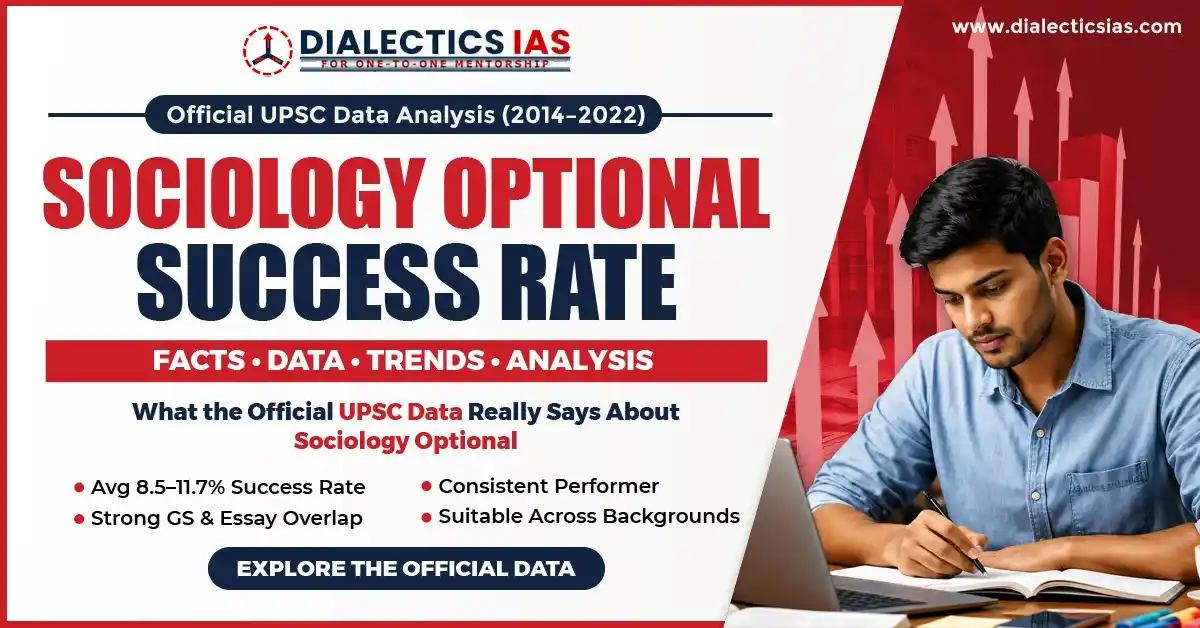
Across nine exam cycles, the success rate has stayed between 8.5% and 11.7% — a stable, predictable band. The one dip in 2016 (5.7%) recovered fully the very next year to 9.6%.
In CSE 2018, Vishal Shah (AIR 63) scored 329 marks in Sociology Optional — the highest recorded optional score in that cycle. Scores between 260 and 285 are consistent for well-prepared candidates year after year. This is what a reliable optional looks like.
Worried that Sociology may feel too theoretical after B.Tech?
Learn how the right guidance can help you transition smoothly and master Sociology answer writing step by step.
What Engineering Training Gets Right — and Where It Can Quietly Damage Your Sociology Score
This is the section you will not find on most coaching pages — because it requires honesty over promotion.
Your engineering background genuinely helps you in Sociology, and in one specific area, it quietly works against you. Both things are true at the same time. Understanding both is what separates aspirants who correct their preparation in time from those who keep getting 220–230 without knowing why.
What Genuinely Helps You
- You are comfortable with abstract conceptual models. Sociological thinkers — Marx, Durkheim, Weber — are theoretical frameworks with clear assumptions and outputs. You can organise them systematically rather than memorising them as a list.
- Thematic consolidation comes naturally to you. Grouping related concepts together, building revision clusters, mapping how one theory relates to another — this is how engineers already manage large domains of knowledge. Sociology responds well to this approach.
- Paper I to Paper II transition is familiar. Theory first, application next — this is exactly how engineering courses are structured. Sociology follows the same pedagogy.
What Quietly Works Against You
Here is where you need to pay close attention. Technical education trains you to arrive at the correct answer — concisely, directly, and without unnecessary elaboration.
This is a valuable skill in engineering. But UPSC Sociology does not assess whether your answer is correct. It assesses the pathway of your reasoning. Think about it this way:
An engineer who writes an answer with three thinkers — factually accurate, logically ordered, clearly concluded — may score between 220 and 230 marks even with strong content knowledge. The answer reads like a technical report. The UPSC examiner is looking for something fundamentally different: a reasoned discussion that:
- Builds an argument step by step
- Considers more than one perspective
- Uses thinkers to support the argument — not just name-drop them
- Connects theory to a real Indian example
- Arrives at a balanced conclusion
This is the opposite of how engineers naturally write.
The Specific Correction You Need to Make
You need to slow down the exposition. Here is the structure that earns marks in Sociology:
- Step 1 → Introduce the concept or thinker
- Step 2 → Explain what the thinker says in the context of this specific question
- Step 3 → Apply it to the issue being asked
- Step 4 → Connect to an Indian empirical example
- Step 5 → Conclude with balance — acknowledge other perspectives
This shift from solution-centric to argument-centric writing does not happen through more reading. It requires deliberate practice under evaluated conditions — with feedback from someone who reads answers the way a UPSC examiner does.
This is precisely what professors at Dialectics IAS work on with candidates in one-to-one live feedback sessions — not through written margin remarks on your copy, but through actual conversation that rebuilds your line of argument together.
Sociology Optional Syllabus for Engineers: How Paper I and Paper II Are Structured
Before you commit to any optional, you need to see the syllabus clearly — not just its length, but its internal logic.
Paper I — Fundamentals of Sociology (The Theory Module)
Think of this as your core theory course. It covers:
- Sociological Thinkers: Marx, Durkheim, Weber, Parsons, Merton, Mead — each offering a distinct explanatory model for how societies function and change.
- Basic Concepts: Social stratification, culture, social institutions, social change, social control
- Research Methods: Qualitative and quantitative approaches, data collection techniques, hypothesis, reliability, and validity
- Sociology as a Discipline: Its scope, comparison with other social sciences, relationship with common sense
For you as an engineer, this paper is familiar territory. Learn the first principles. Understand the model. Then apply. Once you internalise a thinker’s framework, it reappears across multiple topics and questions — so the learning is cumulative, not scattered.
Thinking of switching from a technical background to a scoring humanities optional?
Understand whether Sociology can give you the clarity, overlap, and answer-writing advantage you need for UPSC.
Paper II — Indian Society: Structure and Change (The Application Module)
This paper takes everything from Paper I and applies it to Indian reality. It covers:
- Social Structure: Caste system, class, tribe, religion, family, kinship
- Social Change in India: Rural transformation, industrialisation, urbanisation, social movements
- Contemporary Issues: Population dynamics, gender, communalism, regionalism, poverty, education
The transition from Paper I to Paper II mirrors engineering pedagogy exactly — theory in one module, application in the next. The same concepts recur across both papers, which makes revision efficient rather than repetitive.
One practical takeaway: The syllabus is system-designed, not scattered. Engineers who treat it as a conceptual framework — rather than a content list to memorise — tend to cover it faster and revise it more effectively.
For the complete official syllabus, visit the Sociology Optional Test Series page on the Dialectics IAS website.
GS Papers, Essay, and Interview: Why Sociology Optional Works Across Your Entire Mains Preparation
This is the most practical argument for choosing Sociology — and it matters most if you are already managing a heavy General Studies load.
Here is a paper-wise breakdown of how Sociology Optional connects with the rest of your Mains preparation:
UPSC Paper | How Sociology Optional Helps | Approximate Benefit |
GS Paper I — Indian Society, Social Issues | Paper II of Sociology directly maps to this | 40–50 marks overlap |
GS Paper II — Social Justice, Welfare, Governance | Sociological lens strengthens analysis of welfare schemes, poverty, inequality | 25–35 marks enrichment |
GS Paper IV — Ethics, Values, Human Behaviour | Sociology’s study of norms, socialisation, and social conditioning directly applies | Moderate to strong |
Essay Paper | Themes on gender, inequality, caste, democracy, development appear regularly | High — ready-made frameworks available |
Interview | Balanced perspective on social issues, welfare policy, community dynamics | Valued by interview boards |
An aspirant who has studied Sociology well does not need to separately prepare the Indian Society section of GS Paper I from scratch. The conceptual base is already built.
For engineers already carrying a demanding GS preparation load — History, Geography, Polity, Economy, Environment — this multi-paper return from one optional is a real, measurable efficiency gain. Sociology does not add to your burden. It reduces it.
“UPSC rewards clarity, structure, and originality — not repetition.”
Should All Engineers Choose Sociology Optional? An Honest Answer
Let’s be direct with you here — because this matters more than any marketing pitch.
Sociology Optional is likely a good fit for you if:
- You are comfortable engaging with social issues, current affairs, and questions about how Indian society works.
- You do not mind writing-intensive preparation — meaning you are genuinely willing to practise answer writing regularly, not just read and revise.
- You want your optional to strengthen your GS and Essay preparation simultaneously.
- You are open to adjusting your writing style based on feedback from professors — even if that feedback tells you to unlearn habits you have built over four years.
Sociology Optional may not be the right fit for you if:
- You genuinely find abstract social theory unengaging and struggle to connect with it.
- You want a subject where answers are either clearly correct or incorrect — formula-based and objective.
- You are planning to prepare the optional through passive reading alone without regular evaluated writing practice.
- You are looking for an optional that can be “covered quickly” and then parked — Sociology requires consistent engagement throughout the Mains preparation cycle.
Knowing which category you fall into before making any decision is more useful than any admission offer. This is exactly why Dialectics IAS begins with a counselling session before admission — not to screen aspirants out, but to make sure every candidate who joins is genuinely prepared for what the preparation actually demands.
- Online Batch
Want an optional that is concise, relevant, and easier to connect with current affairs?
See how Sociology helps B.Tech aspirants build conceptual clarity without getting lost in an overly vast syllabus.
How Should an Engineer Prepare Sociology Optional? A Phase-Wise Approach
Engineers work best with a clear, phased plan. Sociology Optional preparation fits naturally into three phases.
Phase One — Syllabus Mapping and Conceptual Foundation (Weeks 1 to 6)
Goal: Concept clarity. Not content volume.
Start by mapping the official UPSC Sociology Optional syllabus into conceptual clusters. Treat each thinker as a model and each social institution — family, religion, caste, class — as a unit of analysis.
What to do in this phase:
- Read Haralambos and Holborn for Paper I theoretical frameworks — this is the standard reference for sociological theories.
- Begin connecting Paper II topics with Paper I concepts from Week 1 itself — do not treat them as separate subjects.
- Build short thinker notes — not long summaries, but model-logic notes: what each thinker argues, under what conditions, and what its limitations are.
- Engage with one UPSC PYQ every few days to understand the kind of questions that actually get asked.
Phase Two — PYQ Analysis and Thematic Consolidation (Weeks 7 to 12)
Goal: Pattern recognition and answer framework building.
Around 50 to 60 percent of UPSC Sociology questions revisit themes from previous years. The framing changes, but the conceptual demand stays similar.
What to do in this phase:
- Map previous year questions paper-wise and topic-wise — you will quickly see which areas appear repeatedly.
- Practise short answer frameworks: Introduction → Thinker Reference → Concept Application → Indian Example → Conclusion.
- Practise these frameworks, but do not mechanise them — UPSC rewards original expression, not templates.
- Begin writing at least two to three short answers per week and evaluate them yourself against the framework.
Phase Three — Evaluated Answer Writing (Weeks 13 Onwards)
Goal: Consistent improvement through external feedback.
This is where preparation either consolidates or stagnates. Writing without feedback is not preparation — it is rehearsing mistakes. For engineering-background aspirants specifically, this phase requires evaluation from someone who understands how UPSC examiners read Sociology answers. Self-checking does not work here — because the writing habit you need to correct is the same one you use to check your own writing.
This is where joining the Sociology Optional Test Series at Dialectics IAS makes the most direct difference — professor-only evaluation, live feedback discussion, and for Premium candidates, answer rewriting to internalise corrections.
For complete details on the test structure and evaluation process, visit the Sociology Optional Test Series page at Dialectics IAS.
Why Answer Writing is the Hardest Adjustment for Engineers — and What Actually Fixes It
Let me describe something that happens very commonly with engineering-background candidates who prepare Sociology.
They cover the syllabus. They understand the thinkers. They can recall Marx’s historical materialism and Durkheim’s social facts from memory. They write full-length practice answers, and then they get evaluated — and the score is somewhere around 220 to 230.
They do not understand why. The content is there. The thinkers are there. The structure looks fine.
The problem is not what they are writing. The problem is how they are writing it.
Early answers from engineering-background candidates tend to be direct, compressed, and conclusion-first. Accurate — but written like a technical explanation rather than a sociological discussion. This is not a fault. It is exactly what four years of engineering education trains you to do.
But UPSC examiners are not verifying whether your answer is factually correct. They are reading whether you can build and sustain a sociological argument — introduce a thinker, explain its relevance to the specific question, apply it to an Indian context, acknowledge a counter-perspective, and arrive at a balanced conclusion.
An answer that lists three thinkers correctly but does not demonstrate why those thinkers are relevant to the specific question being asked will consistently score in the 220–230 range — regardless of how much the writer knows.
The correction requires evaluated feedback — not margin remarks like “add more examples” or “thinker missing,” but a live conversation that goes back through your answer, identifies where the argument broke down, and rebuilds the structure with you.
At Dialectics IAS, every evaluated answer copy is followed by a one-to-one live discussion with professors. No written margin remarks. No outsourcing to assistants. No generic feedback. The Premium Test Series goes one step further — professors may ask you to rewrite specific answers, which forces the argument-building process to become conscious and practised rather than just theoretically understood.
What Professor-Only Evaluation Means — and Why Written Remarks are Not Enough
Here is a distinction worth understanding clearly before you choose any test series.
1) What a standard test series gives you: Your evaluated copy comes back with margin remarks — “thinker missing here,” “conclusion weak,” “needs more examples,” “structure unclear.” These remarks tell you what went wrong. They do not show you how to write it differently next time.
For an engineer who has written in a compressed, conclusion-first style for four years, a margin comment annotates the habit. It does not interrupt it.
2) What a live discussion gives you: A live discussion goes back through the answer with you. It finds exactly where the argument broke down — not just that it broke down. It rebuilds the structure together with you, in real time. You hear the reasoning behind the correction, not just the correction itself.
For engineers who are familiar with design reviews and iterative debugging, this will feel immediately intuitive. Sociology answers, like engineering designs, improve through guided iteration — not through reading a checklist of errors in isolation.
At Dialectics IAS, every evaluated copy is followed by a personal live discussion with professors — online or offline. That conversation is where the actual writing improvement happens.
Not Sure About Sociology Optional Yet? Try One Answer Before Committing
Many engineering-background aspirants tell us the same thing: “I want to try Sociology before I commit to a full test series.” That is a reasonable instinct, and there is a direct way to do it.
The “Let’s Practice” Program at Dialectics IAS: Every Sunday, one UPSC-pattern Sociology Optional question — Paper I or Paper II — is posted on the Dialectics IAS website. Here is how it works:
Step | What You Do |
Step 1 | Write your answer by hand in UPSC Mains format |
Step 2 | Scan or photograph your answer clearly |
Step 3 | Email your answer along with ₹100 evaluation fee to dialectics79@gmail.com |
Step 4 | Professors evaluate your answer personally |
Step 5 | Feedback is returned to you within 12 hours |
The best answer of each week is featured on the Dialectics IAS website. For engineers testing the subject for the first time, one evaluated answer often reveals more about where your writing currently stands than weeks of independent reading.
You see exactly what a professor-level evaluation looks like — and you understand what needs to change — before making any larger decision.
It is low-cost, zero-commitment, and professor-evaluated. Email dialectics79@gmail.com with the subject line: Let’s Practice.
Standard or Premium Test Series — Which One Is Right for You as an Engineer?
Dialectics IAS offers two tracks. Choosing the right one depends on where you are in your UPSC journey.
Feature | Standard Test Series | Premium Test Series |
Who it is for | First-time Mains aspirants | Mains-appeared candidates |
Total Tests | 10 (8 Sectional + 2 Full Length) | 10 (8 Sectional + 2 Full Length) |
Evaluation | Professors only | Professors only |
Feedback | Live one-to-one discussion | Live one-to-one discussion |
Answer Rewriting | Not included | Included — for specific answers |
References / Updates | Core syllabus guidance | Targeted academic references |
Mentorship Intensity | Regular | More intensive, score-improvement focus |
Flexible Schedule | Yes, personalised after counselling | Yes, personalised after counselling |
Fee | ₹15,000 | ₹20,000 |
If you are appearing in Mains for the first time with Sociology Optional, the Standard Test Series gives you enough evaluated cycles to identify and correct writing style issues well before the actual examination.
If you have already appeared in Mains and have a score to reflect on, the Premium Test Series is the more appropriate choice. The answer rewriting component is particularly valuable for engineering-background candidates — it makes argument-building something you practise consciously rather than something you know in theory but cannot yet reproduce under exam conditions.
Both tracks require counselling before admission. Total seats per session are limited to 20 only.
Before Joining: Why Counselling Comes First for Engineers Switching to Sociology
If you are switching to Sociology Optional from an engineering background, you are making a deliberate strategic decision — and it deserves honest assessment before any commitment.
At Dialectics IAS, admission to the Test Series happens only after a one-to-one counselling session with professors. This is not a formality. This is the conversation that determines:
- Whether Standard or Premium is the right fit for you
- What your personalised test schedule should look like
- Where your current writing stands and what specifically needs to change
Two Counselling Options:
Type | Format | Cost | What It Includes |
Standard Counselling | Online or Offline | Free | Discussion on background, preparation level, writing approach, and course recommendation |
Premium Counselling | Online or Offline | ₹500 | Deeper assessment + short written exercise + detailed professor feedback on your answers |
Both sessions are conducted personally by professors — not coordinators, not assistants.
To request a counselling slot, email dialectics79@gmail.com or send a message on WhatsApp at 9811633903 (messages only).
Frequently Asked Questions: Sociology Optional for Engineering Background Students
Ans. Sociology Optional suits engineering-background students well — because its framework-based structure aligns naturally with how engineers process information. According to official UPSC Annual Reports (2014–2022), the subject has maintained a success rate between 8.5% and 11.7% across nine exam cycles.
Engineering graduates have consistently formed over 60% of recommended candidates, and the majority of them chose humanities subjects like Sociology. The adjustment required is in answer writing style — moving from solution-centric to argument-centric — not in understanding the content itself.
Ans. The syllabus can be covered comfortably in four to six months with structured, regular study. Engineers tend to move through Paper I efficiently because of their natural comfort with model-based frameworks. Paper II requires connecting theory to Indian social reality through consistent PYQ practice — this takes a few additional weeks to build fluency.
Preparation time extends noticeably if evaluated answer writing practice is not started early, because writing correction needs its own separate time alongside content revision.
Ans. Yes — scoring 300 or more is achievable, but it requires conceptual clarity, structured answer writing, and regular evaluated practice — not just content coverage. According to UPSC data, Vishal Shah (AIR 63, CSE 2018) scored 329 marks in Sociology Optional — the highest recorded optional score in that cycle.
Scores between 260 and 285 are consistent for well-prepared candidates. The difference between average scores and high scores lies in interpretive depth and argument quality — not in how many thinkers you can recall.
Ans. The syllabus can be covered through self-study with the right books and a structured plan. But the answer writing correction cannot be done alone. Engineers tend to write in a compressed, conclusion-first style that UPSC examiners do not reward.
Correcting this pattern requires evaluated feedback from someone familiar with how UPSC examiners read answers. Self-study without evaluation is coverage; self-study with evaluated practice is actual preparation.
Ans. According to UPSC Annual Reports (66th to 73rd, 2014–2022), Sociology has maintained a success rate between 8.5% and 11.7%. The peak was 2015 at 11.7%. There was a dip in 2016 at 5.7% — which recovered fully to 9.6% the very next year. The 2019–2021 band shows 10.0%, 9.2%, and 8.5% — a stable and consistent subject across a decade of exam cycles.
Ans. Sociology Optional overlaps with approximately 40 to 50 marks worth of GS Paper I questions on Indian Society and social issues. GS Paper II on social justice, welfare, and governance becomes analytically stronger with sociological frameworks already in place.
GS Paper IV on Ethics benefits from sociology's study of values, norms, and social conditioning. The Essay paper regularly features themes — inequality, gender, caste, development — where Sociology provides ready-made analytical lenses. For engineers managing a large GS load, this is a genuine and measurable efficiency gain.
Ans. No — Sociology does not require prior humanities study. It deals with observable social realities — family, caste, class, religion, social change — that any educated reader can engage with using everyday observation and current affairs awareness.
The real difficulty for engineers is not in understanding the content. It is in adjusting the writing style from direct and conclusion-first to discussion-based and argument-building. That adjustment happens through evaluated practice — not through more reading.
Ans. Yes. The "Let's Practice" program at Dialectics IAS posts one UPSC-pattern Sociology question every Sunday. Write your answer by hand, scan it, and submit it by email. Professors evaluate each answer personally and return feedback within 12 hours.
There is no course commitment required. For engineers testing the subject, one evaluated answer often reveals more about your current writing standard than weeks of reading alone. Email dialectics79@gmail.com — Subject: Let's Practice.
Ans. PSIR has the highest number of candidates and the largest syllabus — it is the most popular optional but also the most competitive. Anthropology has a more scientific and technical syllabus that some engineers find comfortable, but fewer coaching options are available.
Sociology offers the shortest syllabus among the three, the highest GS overlap, and the most consistent scoring trend over the years. The right choice ultimately depends on your writing comfort, available preparation time, and how much the subject genuinely engages you.
Ans. Every answer copy at Dialectics IAS is read and evaluated personally by professors — no outsourcing, no assistant checking, no peer review. After evaluation, the copy is returned by email, and a live one-to-one feedback discussion is scheduled with the professor — online or offline. Feedback is shared through this conversation, not through written margin remarks on the copy.
Premium Test Series candidates may be asked to rewrite specific answers to internalise corrections — which is especially useful for engineering-background aspirants who need to practise argument-building consciously.