UPSC Mains 2026 Sociology Optional Paper Analysis: What It Means for Your 2027 Preparation
- Dialectics IAS
- September 16, 2026
- 0 comment
If you sat for UPSC Mains 2026 as a repeater, or you are watching from the sidelines as a 2027 aspirant, you have probably read the Sociology Optional Paper 1 question paper more than once by now. The first reading leaves most people uneasy — the syllabus headings look familiar, but the way the paper used them feels different.
That unease is worth taking seriously. Many 2027 aspirants are now quietly asking whether their notes, their thinker summaries, and even a Sociology Optional Online Test Series for UPSC 2027 still fit their plan the way they assumed a few months ago. This article (UPSC Mains 2026 Sociology Optional Paper Analysis) works through the 2026 paper properly, section by section, so you are reacting to what actually happened, not to a rumour on a Telegram group.
Quick Answer
The 2026 Sociology Optional paper kept the syllabus unchanged but shifted emphasis. Methodology carried 80 marks across six questions. Thinkers were tested through comparison, not recall, and kinship shrank to one sub-question. Both papers rewarded concrete Indian examples tied to a named concept. For 2027, this means more evaluated answer-writing, not more passive reading.
Key Takeaways
- The syllabus has not changed for 2027; the weightage and framing of questions has.
- Methodology carried unusually heavy weight in 2026 — treat it as central, not optional.
- Thinkers are being tested through comparison and critique, not through memorised lines.
- No chapter, including kinship, is permanently safe from being trimmed to a single sub-question.
- Both papers rewarded Indian examples anchored to a named sociological concept.
- The honest response to this paper is more evaluated writing practice, not more re-reading.
The 2026 Paper Leaned Harder on Sociology as Science Than Most Aspirants Expected
Methodology carried more weight in the 2026 paper than any other single block. Six questions, adding up to 80 marks, came directly from Sociology as Science and Research Methods and Analysis — positivism against interpretivism, the objectivity problem, grounded theory versus theory-driven research, and a question weighing the limits of intersectionality as a research approach.
This is the section most aspirants postpone. It feels abstract next to a chapter like social stratification, where a concrete example lets you move on quickly. But in 2026, methodology outweighed Sociological Thinkers, Social Stratification, and every other substantive chapter taken individually.
Here is roughly how that block broke down.
Sub-topic tested | Approx. weight | What it actually asked |
Positivism, interpretivism, objectivity | 30 marks | Compare paradigms, not just define them |
Grounded theory vs theory-driven research | 20 marks | Distinguish approach, not list features |
Intersectionality as a research method | 20 marks | Its uses and its genuine limitations |
General methods and data-collection questions | 10 marks | Applied, short-answer style |
Even the intersectionality question was framed as a limitation-finding exercise, not a definition question. Describing what intersectionality does well is the easy half of that answer.
The harder half — that the number of intersecting categories can multiply endlessly, that it resists quantification, and that it can fragment a collective political claim into finer description — is what separated a full answer from a half answer.
Why Did Kinship, a Reliable Scoring Chapter, Almost Disappear?
Kinship shrank to a single 10-mark sub-question in 2026, built around the patriarchal bargain within marriage. Family, household forms, lineage and descent, and contemporary trends in kinship — usually a dependable topic — were simply absent this time.
This is worth sitting with for a moment. Kinship has long been treated as one of the “safe” chapters: compact syllabus, clear thinkers, predictable questions. The 2026 paper is a reminder that no chapter carries a permanent guarantee.
A candidate who revised kinship for eight hours and glanced at methodology for one would have felt that imbalance directly in the exam hall. The lesson is not to abandon kinship. It is to stop assuming a chapter’s past reliability predicts this year’s paper.
Paper I Versus Paper II: How the Two Talked to Each Other in 2026
Paper I and Paper II were not treated as separate subjects in 2026 — they leaned on each other constantly. Several questions in both papers rewarded a candidate who could connect a Paper I concept to a concrete, contemporary Indian example.
- A Paper I question asked candidates to describe the impact of the capitalist mode of production on society — a Marx concept that only comes alive with a current, Indian illustration.
- Another asked how class and caste intersect and overlap in shaping social structure, sitting exactly between Paper I stratification theory and Paper II’s caste discussion.
- A third asked candidates to differentiate social hierarchy from social exclusion, using the caste system as the substantiating example.
- Migration, rural households, and the position of women in the informal economy all appeared as questions needing a named concept and a real Indian case, not description alone.
If you have been preparing Paper I and Paper II as two separate subjects with two separate note files, the 2026 paper makes a fairly strong case for stopping that habit now.
If Your Thinkers Preparation is Still Quotation-Based, This Paper is a Warning
Thinkers were tested through comparison and critical application in 2026, not recall of their positions. One question asked candidates to describe the impact of the capitalist mode of production on society, which needs Marx’s framework applied, not recited. Elsewhere, the paper asked candidates to critically evaluate different sociological approaches side by side.
A student who has memorised “Durkheim said this, Weber said that” as disconnected lines will struggle here. A student who has learned to place two thinkers in conversation, and apply that conversation to an Indian example, will not.
This is exactly the shift that rewards preparing sociological thinkers for application rather than recall — building a working understanding of each thinker’s core argument, and practising how it would answer a question that never even names the thinker.
Submit This Week’s Answer
A low-pressure way to start writing again, one question at a time.
Every Sunday, Let’s Practice shares one Sociology question for professor evaluation — a small, steady habit that builds exactly the application skill this paper rewarded.
What Six Recurring Themes Tell Us About the Syllabus for 2027
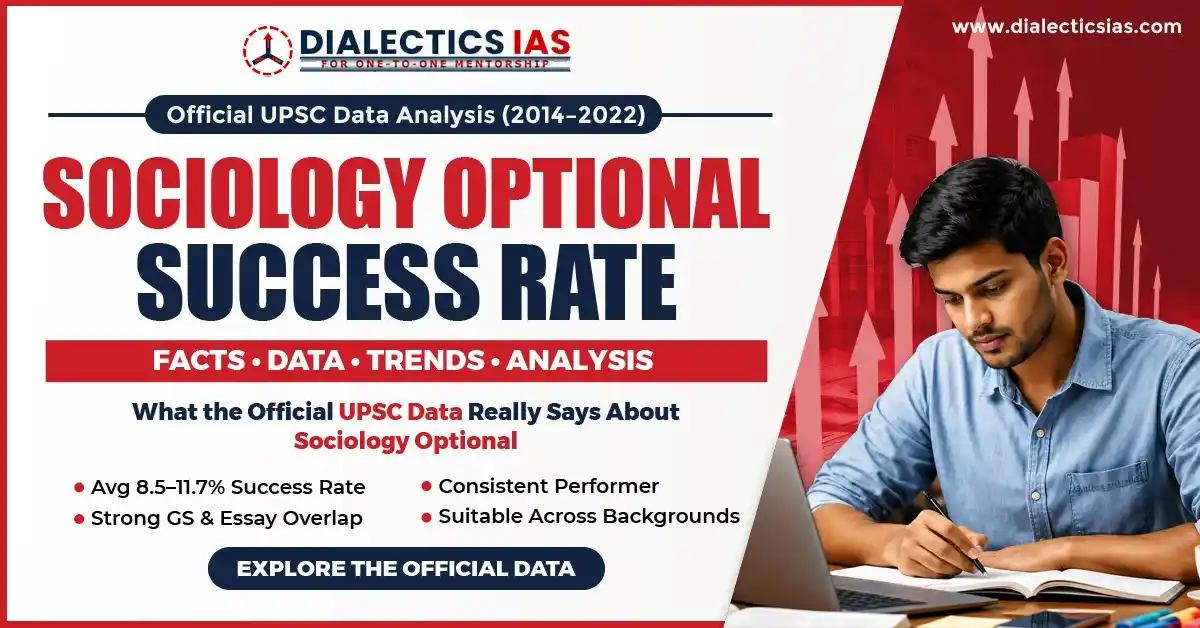
Objectivity, positivism, caste, colonialism, social movements, and population dynamics recur far more often than they get replaced. That pattern held again in 2026.
A genuine Sociology Optional PYQ set going back several years shows these six threads appearing in some form almost every time, even when the phrasing changes.
This is genuinely useful for a 2027 aspirant. The syllabus is not moving under your feet each year — the framing is. A paper that “feels different” is usually the same core themes asked from a new angle, which is why solving old papers properly, not just reading model answers for them, remains high-value.
Should a 2027 Aspirant Change Their Entire Strategy Because of One Paper?
No — the syllabus for 2027 is unchanged, so a complete overhaul is not what this paper calls for. What it calls for is recalibration: checking that your time allocation matches where marks are actually landing, rather than where you assumed they would.
The Sociology Optional syllabus for 2026-27 still covers the same discipline, the same six core thinkers, the same research methods block, and the same Indian society structure in Paper II. What moved is emphasis — methodology carrying more weight, kinship carrying less, and both papers rewarding applied Indian examples over descriptive answers.
Where the Marks Actually Went in 2026 — A Chapter-Wise Reading
Based on a question-wise reading of the released paper, here is a rough sense of where the weight sat this year. This is an observation from the paper itself, not an official UPSC weightage report, so treat it as a guide rather than a fixed formula.
Area | Approx. share of Paper 1 | Note |
Sociology as Science / Research Methods | Around one-fifth | Heaviest single block this year |
Sociological Thinkers | Substantial, but applied | Tested via comparison, not recall |
Systems of Kinship | Minimal (10 marks) | Compressed to one sub-question |
Social Stratification, Social Change | Steady | Consistent with past trends |
The honest takeaway is not “study only methodology.” It is “do not let any one block, including the comfortable ones, absorb a disproportionate share of your revision hours.”
Explore the Test Series
Structured, professor-evaluated practice for exactly this kind of applied writing.
A Sociology Optional Online Test Series for UPSC 2027 gives you ten tests, evaluated only by professors, with individual feedback on exactly where each answer needed sharper application, not just more content.
Why an Evaluated Sociology Optional Test Series Matters After a Paper Like This
A paper that rewards comparison, application, and Indian examples cannot be prepared for by reading alone. You can understand positivism perfectly in your head and still write a flat, descriptive answer under exam pressure if nobody has pointed out that specific weakness to you.
Writing one answer is useful. Writing the same kind of answer twenty times, each time with someone experienced telling you exactly where the argument thinned out or where an Indian example would have carried more weight — that is what actually changes how you write under exam conditions.
What This Means Differently for Beginners, Repeaters and Working Professionals
The 2026 paper does not affect every kind of aspirant the same way. Where you already stand in your preparation decides what to do next.
- Beginners should build methodology alongside thinkers from the start, rather than leaving it for later. Given how it performed this year, postponing it is a real risk.
- Repeaters often carry the habit of writing thinkers as isolated quotations. That habit needs conscious unlearning now, through test series practice built specifically for repeat aspirants.
- Working professionals with limited daily hours should prioritise PYQ-linked, application-focused writing over exhaustive first reading. Depth in fewer, well-practised areas beats shallow coverage of everything.
How Should You Actually Revise Over the Next Few Months?
Start with a PYQ mapping exercise, not another round of reading. Go through the last five to seven years of papers and note, honestly, which of the six recurring themes you can answer confidently under time pressure, and which you cannot.
- Map each PYQ theme against your current notes and mark the genuine gaps.
- Rebuild thinker notes around comparison and application, not isolated summaries.
- Drill methodology specifically — it earned real weight this year and deserves dedicated hours.
- Write one full-length answer a week under timed conditions and get it reviewed honestly.
- Revise on a fixed cycle rather than only when you feel ready to.
If your remaining time is genuinely short, a structured 90-day preparation plan is often more useful than an open-ended one, simply because it forces sequencing decisions you might otherwise keep postponing.
Frequently Asked Questions
No. The syllabus is unchanged. What shifted was emphasis — methodology carried more weight, and thinkers and kinship were tested differently than in recent years.
Yes, provided your preparation matches how the paper actually tests you now — through application and comparison rather than description or recall alone.
A few precise lines still have value, but the paper rewarded candidates who could compare thinkers and apply their frameworks to a real example, which quotation alone cannot do.
Treat it as a core block, not a side topic. It carried around a fifth of Paper 1's marks this year, more than any single substantive chapter.
Yes. The framing changes each year, but the same six or seven themes — objectivity, caste, colonialism, social movements, population dynamics among them — keep recurring.
Not your whole strategy. Focus specifically on unlearning quotation-based thinker writing and adding regular, evaluated application practice.
Analysis tells you what changed. Writing under evaluation is what actually changes how you respond to that shift when you are under exam pressure.
Yes — by prioritising PYQ-linked, application-focused writing over exhaustive first reading, and by keeping a fixed weekly writing habit rather than an open-ended one.
It helps considerably. Several 2026 questions rewarded candidates who could connect a Paper I concept directly to a Paper II, Indian-society example.
As soon as basic syllabus coverage is reasonably underway. Waiting until every chapter feels "complete" usually means starting evaluated writing too late.
Conclusion
The 2026 Sociology Optional paper did not rewrite your syllabus. It rewrote what counts as being prepared. A student who has read every chapter but never written a full-length, application-based answer under evaluation is, this year, at a real disadvantage against one who has written fewer chapters, but written them well, repeatedly, with honest feedback.
If you take one thing from this UPSC Mains 2026 Sociology Optional Paper Analysis into your 2027 preparation, let it be this: start writing now, not later. If you would like help working out where your own preparation stands against this shift, you are welcome to request a free counselling conversation before deciding your next step.