How to Build a Sociology Optional Study Plan for UPSC 2027: From Concepts to Test Practice
- Dialectics IAS
- September 23, 2026
- 0 comment
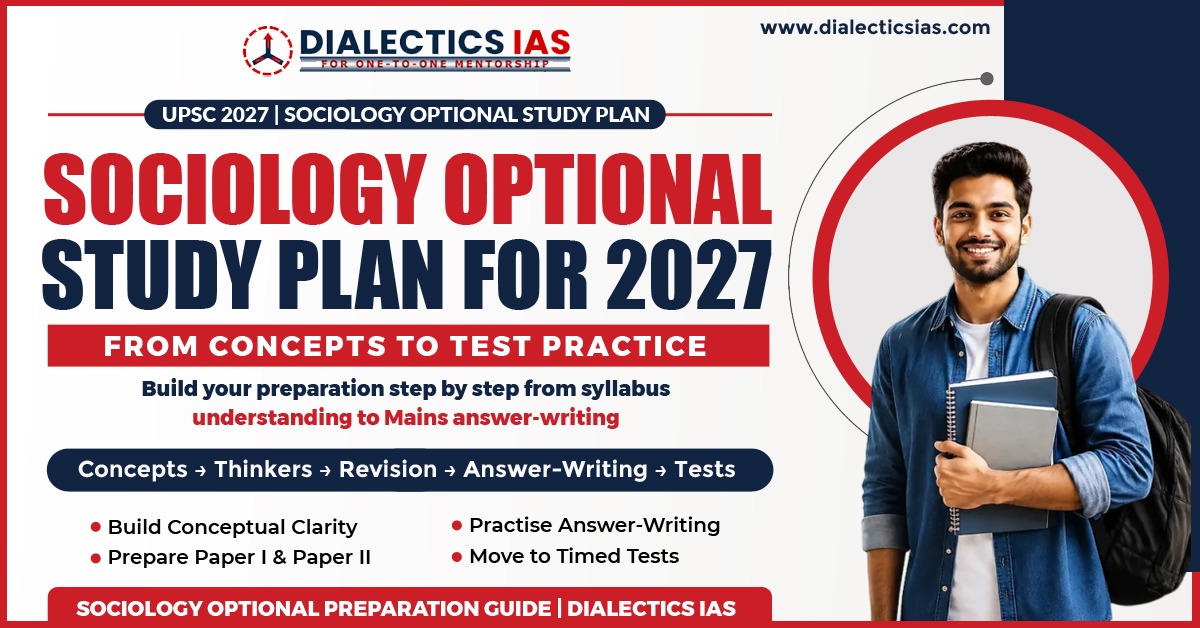
Most Sociology Optional aspirants do not struggle because they read too little. They struggle because nobody ever showed them what to read first, what to read second, and when to stop reading and start writing. A Sociology Optional study plan for UPSC 2027 is not a bigger reading list. It is a sequence.
If you have already finished one reading of the syllabus and still feel unsure what to do next, this is a common place to be. The subject rewards structure far more than it rewards speed.
Quick Answer
A workable “Sociology Optional study plan for UPSC 2027” usually runs five to six months. Begin with Paper I concepts and thinkers, move to Paper II with Indian examples, start answer writing once you have covered 40–50% of the syllabus, and join a test series only after at least one complete reading.
Key Takeaways
- Sequencing matters more than how fast you read
- Concepts and thinkers come before Paper II detail, not after
- Answer writing should begin mid-syllabus, not once everything is “finished”
- A test series works best after one full reading, not before it
- Working professionals and self-study students need different pacing, not a different subject
- A short conversation with a professor can turn a general plan into one built for your stage
Most Study Plans Fail at Sequencing, Not Effort
A study plan fails when the order is wrong, not when the effort is missing. Aspirants often read Paper I and Paper II together, chapter by chapter, without ever building a strong base in either.
Sociology is a subject built on interlinkage. Paper I gives you the theoretical language — social facts, social action, structural functionalism, symbolic interactionism. Paper II then asks you to apply that language to Indian society: caste, gender, family, urbanisation.
If Paper I is shaky, Paper II answers stay descriptive. You end up writing about issues without using sociological concepts to explain them, which is exactly what UPSC examiners mark down.
A good plan solves this with sequence: concepts first, application second, writing throughout, and revision layered on top — not squeezed in at the end.
How Long Does Sociology Optional Actually Take to Prepare?
Five to six months of focused, sequenced study is usually enough for a first attempt, provided answer writing begins early rather than at the very end.
This is not a fixed number. A working professional with two hours a day may need seven to eight months for the same depth. A student with prior background in sociology, or one who has attempted the exam before, may compress this to four months.
What matters is not the total number of months but whether each month has a clear purpose. A plan with six vague months of “revision” is weaker than a plan with four sharply defined ones.
A Month-by-Month Sociology Optional Study Plan for UPSC 2027
The table below gives a realistic shape for a five-to-six-month plan. Treat it as a starting framework, not a rigid schedule — the right pace still depends on how much time you actually have each day.
Month | Focus |
1–2 | Paper I fundamentals, sociology as science, research methods, thinkers |
3 | Remaining thinkers, begin weekly answer writing |
4 | Paper II — Indian society, structure and change |
5 | Paper II continued, integrate current affairs, join a test series |
6 | Full-length tests, revision, weak-area correction |
Aspirants with less time available can compress months 1–2 into one, provided they accept a narrower first reading and rely more heavily on the full Sociology Optional syllabus as a checklist rather than reading every source cover to cover. If you are within ninety days of the exam rather than starting fresh, a plan built specifically for the final stretch will serve you better than this longer version.
Paper I First, or Paper II — Which Should Come First?
Paper I should come first, in almost every case. It is the conceptual foundation Paper II depends on. Some aspirants, especially those from a social science background, are tempted to start with Paper II because it feels more familiar and closer to current affairs. This can work, but it usually means revisiting Paper I concepts later anyway, once the gaps in application become visible.
Starting with Paper I is slower in the first month and faster in every month after that. Starting with Paper II feels faster at first and slower later, once theory catches up with you mid-syllabus.
If you genuinely have a strong sociology background already — a graduate degree in the subject, for instance — running both papers in parallel from month one can work. For most aspirants, sequence beats parallel reading.
Submit This Week’s Answer
A low-pressure way to start writing again, one question at a time.
Every Sunday, Let’s Practice shares one Sociology question for professor evaluation — a small, steady habit that builds exactly the application skill this paper rewarded.
Building Conceptual Clarity in the Six Thinkers
The six core thinkers — Marx, Durkheim, Weber, Parsons, Merton, and Mead — are not a memorisation task. They are the vocabulary you will use throughout both papers.
Treat each thinker as three separate pieces: the core concept, one or two keywords associated with it, and one Indian example you can apply it to. A thinker learned only as a definition rarely survives into an actual Mains answer.
Preparing the six thinkers systematically — rather than reading them once and moving on — is what usually separates answers that merely mention a thinker from answers that actually use one to build an argument.
Beginners without a background in sociology sometimes benefit from a structured introduction to this section rather than working through it alone. A structured Paper I course can shorten the time it takes to get comfortable with this vocabulary, though it is not the only way to get there — many aspirants build this clarity through disciplined self-study alone.
Where Most Study Plans Quietly Break Down: Answer Writing
Most study plans do not fail during reading. They fail because answer writing gets postponed until “after the syllabus is done” — and by then, there is no time left to build the skill properly.
Writing a Sociology answer is a different skill from understanding Sociology. It requires structuring an introduction, applying a thinker correctly within a word limit, and linking theory to a current example — all within roughly ten to twelve minutes for a 10-mark question.
This skill takes practice to develop. Reading about it is not the same as doing it repeatedly and receiving honest feedback on where the structure breaks down. A plan that saves all its writing practice for the last month is really a reading plan with a writing problem attached.
When Should You Start Answer-Writing Practice?
Start answer writing once you have covered roughly 40–50% of the syllabus — not after finishing it completely.
At this stage, write two to three answers a week rather than one a day. The goal early on is structure, not volume: introduction, use of a thinker or concept, one clear Indian example, and a short conclusion.
A simple, low-pressure way to build this habit early is a weekly practice routine rather than a full test series. The weekly Let’s Practice initiative exists for exactly this stage — one question a week, evaluated, before you are ready for a full-length test.
Explore the Test Series
Structured, professor-evaluated practice for exactly this kind of applied writing.
A Sociology Optional Online Test Series for UPSC 2027 gives you ten tests, evaluated only by professors, with individual feedback on exactly where each answer needed sharper application, not just more content.
Self-Study, Guided Preparation, or a Mix — What Actually Fits Your Plan?
Both self-study and guided preparation can work for Sociology Optional. The right choice depends on your background, your available time, and how confident you already feel with the thinkers.
Self-study suits aspirants who already read comfortably on their own, have four to five hours a day available, and are disciplined about writing practice without external prompting.
Working professionals with limited evening hours, and beginners with no prior sociology background, often find a structured course helps them cover ground faster in the concept-building phase — without it needing to replace self-study for the rest of the plan.
Neither path removes the need for feedback on your written answers. Self-evaluation has limited value in a subject where structure and argument matter as much as content.
Mains repeaters usually need a third variation: less time on fresh reading, more time on rewriting and refining answers that already have the right content but not the right structure.
Is a Test Series Necessary, and When Should You Join One?
A sociology optional online test series becomes useful once you have completed at least one full reading of both papers — not before. Joining too early means you spend each test struggling with content rather than improving how you write.
Before that point, weekly practice on individual questions is more useful than full-length tests, because it isolates one skill at a time rather than testing everything together under pressure.
Once your first reading is complete, Sociology Optional Test Series practice does two things a study plan alone cannot: it simulates the actual three-hour exam pressure, and it gives you outside evaluation on where your structure and application are genuinely weak, rather than where you assume they are weak.
If you are returning to the exam after a previous attempt, your test-series needs are usually different from a first-time aspirant’s — more focus on rewriting and refining existing answers, less on building from scratch.
Common Mistakes That Quietly Derail a 2027 Study Plan
- Reading Paper I and Paper II simultaneously without finishing either properly first
- Postponing answer writing until the syllabus feels “complete”
- Joining a test series before finishing a first reading
- Treating thinkers as definitions to memorise instead of tools to apply
- Following a plan copied from someone else’s timeline instead of your own available hours
- Skipping written feedback and relying only on self-assessment
Plan Your Preparation With the Right Support
Starting with Paper I and the thinkers?
Many beginners find the concept-building phase easier with structured lectures rather than working through it alone from scratch.
Explore the Paper I Online Course → https://dialecticsias.com/sociology-optional-paper-i-online-course/
Finished your first reading?
Once your first reading is done, structured answer-writing practice with honest evaluation is what actually improves your Mains score.
View Sociology Optional Test Series → https://dialecticsias.com/sociology-optional-test-series/
Not sure where your plan should start?
A short conversation can tell you whether you need a full plan from month one, or just help with a specific stage.
Request Counselling → Popup Form
If you would rather message directly and describe your stage yourself:
Message Us on WhatsApp
Frequently Asked Questions
Five to six months of sequenced study is usually enough, provided answer writing starts mid-syllabus rather than at the end. Working professionals may need seven to eight months at a slower daily pace.
No. Start once you have covered 40–50% of the syllabus. Waiting until everything is "finished" leaves too little time to actually build the writing skill.
Yes, for aspirants with strong reading discipline and enough daily time. It still requires outside evaluation of your written answers, since self-assessment has limited value in a structure-driven subject.
After at least one complete reading of both papers. Joining earlier usually means struggling with content instead of improving structure and timing.
Extend the timeline rather than compress the syllabus — seven to eight months at two focused hours a day, with weekends used for writing practice rather than fresh reading.
Usually, yes. Repeaters generally need less time on fresh reading and more time on rewriting existing answers for better structure and sociological depth.
Paper I, in almost every case, since it builds the theoretical vocabulary Paper II depends on. Aspirants with a strong prior sociology background are the main exception.
Three to four focused hours daily is a reasonable target for a five-to-six-month plan, with weekends allowing extra time for revision and answer writing.
Not necessary for everyone. Beginners without a sociology background often move faster through the concept-building phase with structured lectures; aspirants with some background often manage well on their own.
Treating the plan as a reading list instead of a sequence — and pushing answer writing to the very end, when there is no longer time to build that skill properly.
Where This Leaves You
A Sociology Optional study plan only works if it is sequenced to where you actually are, not copied from a topper’s timeline or a generic month-by-month chart. Concepts before application, writing throughout rather than at the end, and a test series only once you have something worth testing — that order matters more than any single resource you choose.
If you want this general roadmap turned into a plan for your specific stage, a free counselling conversation is the simplest next step.