
Sociology Optional Online Module for Paper I

Module I (Online) Course

Are you struggling with sociological thinkers, research methods, or sociology as a science? If you find it difficult to understand Paper 1 or struggle to write clear answers, then the Sociology Optional Paper I Online Course by Dialectics IAS is designed for you.

Book a free counselling

Build Strong Conceptual Clarity with Sociology Optional Online Module I

Many UPSC aspirants read Sociology Optional Paper I multiple times but fail to connect concepts and write structured answers. Dialectics IAS’s Sociology Optional Module I for UPSC is designed exactly for this gap through structured sociology online lectures.


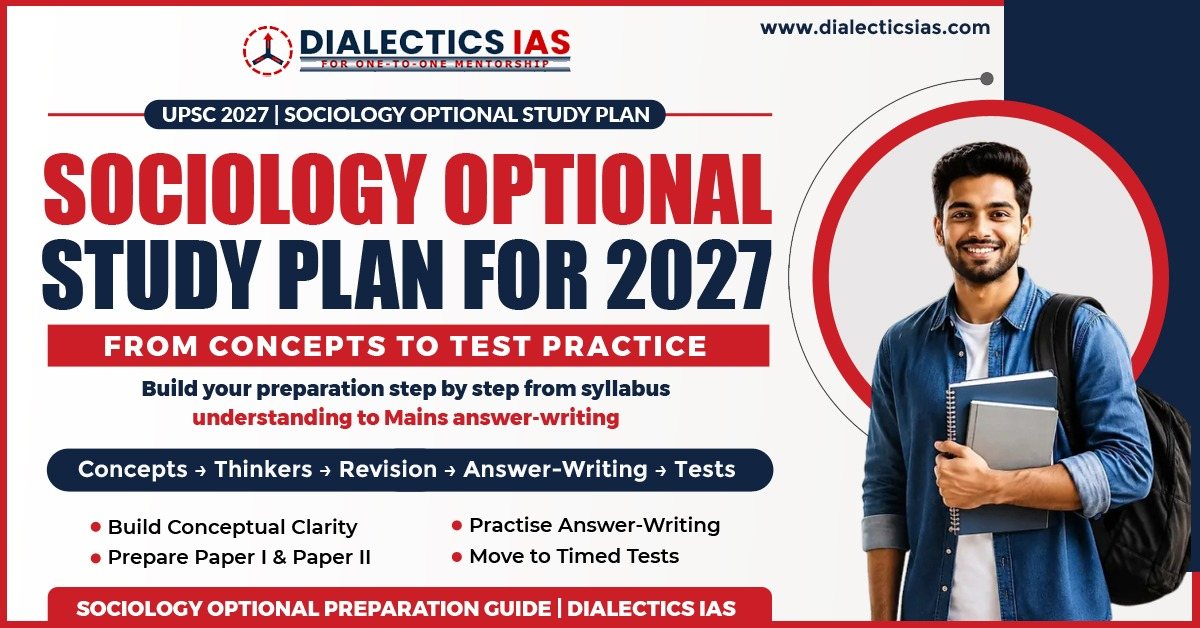
The Sociology Optional Online Course by Dialectics IAS covers Paper I thinkers, research methods, and sociology as a science through online lectures and professor guidance. The course helps you develop conceptual clarity, strengthen your analytical thinking, and improve your answer-writing.

Complete Sociology Optional Paper I Course Curriculum & Lecture Plan

This module includes approximately 30 Lectures (Online) covering the most important and at the same time considered as most difficult aspects of the Sociology Optional. It also includes 2 Doubt-Clearing Sessions and 2 Sectional Tests of 250 Marks each to train the candidates in answer-writing for the Main Examination. Throughout the course, candidates will be mentored and monitored by the dedicated and experienced professors.

Before starting preparation, it is important to clearly understand the official sociology optional syllabus. A well-defined syllabus helps you plan answer writing, revision, and test practice in a structured way for the UPSC mains. So let’s have a look at the official syllabus of sociology optional below.

Module I (Heart of the Sociology Optional)

In this lecture, we will briefly look at some of the key concepts in Sociology. An understanding of these concepts is essential for an overall understanding of the social structure and process of social change in society. We will also try to understand the relationship between Sociology and Common-Sense.

    • What is Society? What is Scientific Study?
    • Society as a Structure and Society as a Process
    • Community (Differences between Society and Community)
    • Association (Difference between Association and Community, Community within Association)
    • Institution (Social Norms, Customs and Institutions; Folkways and Mores; Crescive and Enacted Institutions)
    • Culture (Ethnocentrism, Xenocentrism, Cultural Relativism, Subculture, Contraculture, Cultural Lag, Civilization)

This lecture aims at providing an understanding of the historical context of the emergence of sociology as a distinct social science. An in-depth analysis of socio economic and political conditions prevailing in Europe in the post-Renaissance period would enable the learner to acknowledge the need for a distinct discipline which could study society and its dynamics in a scientific manner. Further, an introduction to intellectual debates during the enlightenment period would help the learner understand both, goals of sociology as well as means (in terms of
methodology) that was advocated by the founding fathers of the discipline.

Features of Medieval European Society, Renaissance (14th century), Commercial Revolution (15th century), Scientific Revolution (15th century), Religious Reformation (16th century), Agricultural Revolution (16th century), Industrial Revolution (mid-18th century), Enlightenment (late 18thcentury and early 19thcentury), French Revolution (1789), Conservative Reaction to the Enlightenment (Counter-Enlightenment)

Scope of Sociology, Sociology and other Social Sciences, Sociological Imagination, Post-Modernism

Science, Scientific Method and Critique, Major Theoretical Strands of Research Methodology, Positivism and its Critique, Fact, Value and Objectivity, Non-Positivist Methodologies

Qualitative and Quantitative Methods, Techniques of Data Collection, Variables, Sampling, Hypothesis, Reliability and Validity

PAPER – II: INDIAN SOCIETY: STRUCTURE AND CHANGE

Historical Materialism, Mode of production, Alienation, Class Struggle

Division of Labour, Social Fact, Suicide, Religion and Society

Social Action, Ideal Types, Authority, Bureaucracy, Protestant Ethic and the Spirit of Capitalism

Social System, Pattern Variables

Latent and Manifest Functions, Conformity and Deviance, Reference Groups

Self and Identity

Total Seats: 20
Fee: Rs. 8,000 (with Sectional Tests); Rs. 5,000 (without Sectional Tests)

Achievement

Check Our Successful Students That Speak For Themselves

At Dialectics IAS, we believe better sociology answers start with stronger concept clarity instead of memorisation. Our experienced professors focus on conceptual clarity and encourage original thinking. Let's check out some of our successful results.

Chandramohan Garg

Rank: 25
Year: 2015-16

Aparna Gupta

Rank: 38
Year: 2017-18
Marks: 303

Syeed Fakhrudin Hamid

Rank: 86
Year: 2016-17

Benson S Ninan

Rank: 90
Year: 2017-18
Marks: 305

Apurv Chauhan

Rank: 148
Year: 2017-18
Marks: 270

Ankit Yadav

Rank: 191
Year: 2017-18
Marks: 280

Sumit Kumar Singh

Rank: 229
Year: 2020-21

Sonia Nain

Rank: 244
Year: 2015-16

Harsh Singh

Rank: 244
Year: 2017-18
Marks: 290

Arun Balgotra

Rank: 280
Year: 2020-21
Marks: 271

Vivek Rathee

Rank: 390
Year: 2015 -16

Apurv Chauhan

Rank: 438
Year: 2016-17

Abhijeet Yadav

Rank: 653
Year: 2017-18
Marks: 279

Shilpa Bhatti

Rank: 712
Year: 2017-18
Marks: 264

K. Subhash

Rank: 825
Year: 2022-23
Marks: 272

W. Aotula Ozukum

Rank: 874
Year: 2022-23
Marks: 265
And many more… 1500+ selections including IAS, IFS & IPS
Not Sure If Module I is Right for You?

If you would like to understand whether Module I suits your current preparation level, request a counselling session with us.

Male teacher writing on board in realistic classroom.
Welcome to Dialectics IAS

Sociology Optional Paper I Online Course for Serious UPSC Aspirants

Dialectics IAS is a professor-led academic initiative dedicated exclusively to UPSC Sociology Optional preparation. We provide one-to-one mentorship and invite only serious, very serious civil service aspirants to our very limited seats. 


Our Sociology Optional online module course is a structured, Paper I-focused programme that is built around lectures, doubt-clearing sessions, and evaluated tests. The course is designed for aspirants looking to build conceptual clarity in sociology as a science, research methods, and core Paper I concepts.

Why Students Trust Dialectics IAS

Why Choose Dialectics IAS for Sociology Optional Paper I Preparation

Most sociology optional aspirants read Paper I but still struggle to write clear answers. They struggle because Paper I feels scattered. This is exactly where Dialectics IAS’s sociology optional online module course for UPSC becomes useful — not as a shortcut, but as a way to bring structure to a syllabus that otherwise feels like too much, too fast.

Professor-Led Teaching & Evaluation

Every lecture is delivered by professors, and every sectional test is evaluated personally by the professor who taught it — no outsourcing at any stage.

Focus on Core Paper I Concepts

Research Methods, Sociology as Science, and all six thinkers are explained in depth, with the difficulty of each topic addressed directly rather than rushed.

Live One-to-One Discussion

The course is 100% online – attend from anywhere. Live one-to-one discussions with professors, with dedicated doubt-clearing sessions for clarifying concepts.

Limited Seats – Only 20

We provide only 20 seats for serious aspirants, and counselling before admission ensures the module fits your actual preparation stage.

books, plants, and charts visible, balanced

Who Should Join Sociology Optional Online Module I at Dialectics IAS

The Sociology Optional Paper I Online Module Course is designed for serious UPSC aspirants who are stuck on specific foundations of Paper I: Sociology as Science, Research Methods, or the six major thinkers. It is suitable for beginners from engineering, science, or commerce backgrounds; Mains returnees; and working professionals.

Some Key Features of Sociology Optional Online Module I for UPSC

The Sociology Optional Paper I Online Course at Dialectics IAS covers sociology – the discipline; sociology as science; research methods and analysis; and all six major thinkers. The module I includes around 30 online lectures, two doubt-clearing sessions and two sectional tests of 250 marks each.

Why Choose Sociology Optional for UPSC Mains

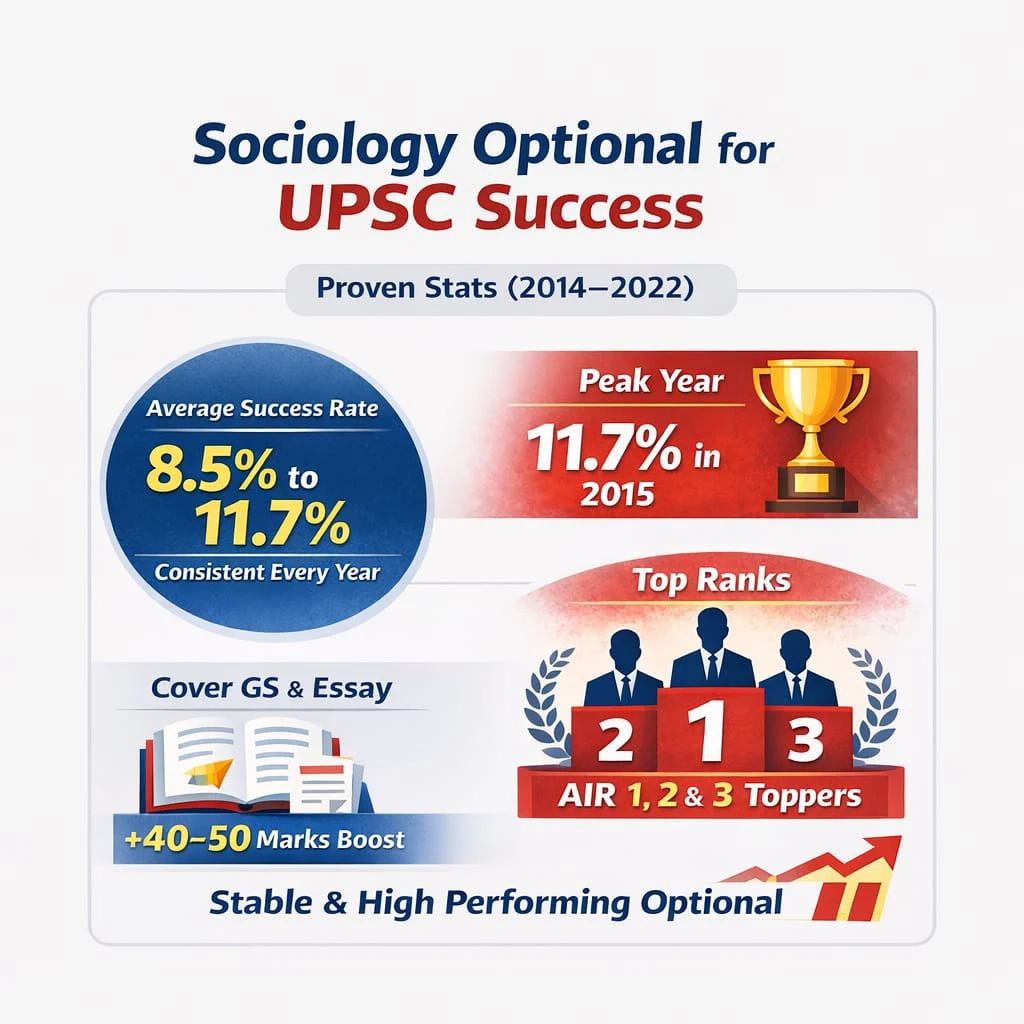
Sociology has consistently remained a high scoring optional in UPSC mains. Official UPSC data from 2014 to 2022 shows stable success rates between 8.5 to 11.7 percent. Even as competition increased, sociology continued to deliver results. It also overlaps with the GS syllabus, and the essay also adds a strategic advantage for serious aspirants.

Sociology Optional Test for UPSC Success

How Many Marks Does Sociology Optional Overlap with the UPSC GS Papers and Essay?

One of the biggest advantages of choosing Sociology Optional is its substantial overlap with the UPSC Civil Services Mains syllabus. Although UPSC does not officially specify the extent of this overlap, Sociology Optional is widely regarded as one of the subjects with the strongest conceptual connection to the General Studies papers and the Essay paper. Depending on the year's question paper, this overlap can support answers worth approximately 300–350 marks across GS Papers I, II, IV, and the Essay paper.
Here's a broad overview of where this overlap is most visible:

GS Paper I (around 75–100 marks)

Sociology directly complements the Indian Society section, covering topics such as diversity, social empowerment, communalism, regionalism, secularism, globalisation, and developmental issues. Many questions in this section can be answered more effectively using sociological concepts and perspectives.

GS Paper II (around 50–75 marks

There is considerable overlap with Social Justice and governance-related themes. Sociological theories and concepts strengthen answers on issues concerning women, children, older persons, vulnerable sections, poverty, education, healthcare, NGOs, and welfare schemes.

GS Paper IV – Ethics (around 50 marks)

Sociology helps develop a deeper understanding of human behaviour, values, social responsibility, and justice. These perspectives can enrich both Section A theoretical questions and Case Studies by adding balanced and analytical reasoning.

Essay Paper (around 100–125 marks)

Many UPSC essays focus on social themes such as women's empowerment, education, urbanisation, inequality, social change, technology, and globalisation. Sociology provides conceptual frameworks, relevant thinkers, and contemporary examples that help build well-structured, analytical, and balanced essays.

Note: The figures above are indicative estimates based on the recurring themes and syllabus overlap observed in previous UPSC Mains examinations. The actual overlap may vary depending on the questions asked in a particular year.

Ready to Master Sociology Optional Paper I?
Looking for focused sociology optional paper 1 preparation? Join our Module I that builds strong sociology optional concepts through structured lectures, doubt-clearing sessions, and professor-led guidance.

What Aspirants Say About Sociology Optional Online Course by Dialectics IAS

The Sociology Optional Paper I becomes easier when concepts are explained clearly and linked to answer writing. Here is what our students have to say about their learning experience with Dialectics IAS.

I had read Marx and Weber several times, but writing them into a ten-mark answer never felt natural. The lectures focused on building the argument, not just the definition, and that made the difference.

Animesh Sharma

Research methods always felt confusing before joining Module I. The professors explained every concept with clarity, making answer writing much easier.

Sneha Verma

I come from an engineering background; sociology as a science was the hardest section for me. The doubt-clearing session before the test genuinely helped me structure my understanding.

Priyanka Mishra

I only wanted help with the thinkers, not a full course. Module I lets me do exactly that. The doubt-clearing sessions were extremely valuable. You don’t just get answers – you learn how to think.

Saurabh Mishra

The step-by-step explanation of sociology as science and research methods made difficult topics much easier to understand. The teaching approach was clear and practical. Thank you, Dialectics IAS.

Akash Yadav

Still Have Questions? We Are Here to Help

If you have any questions, reach out to us directly. We respond to every enquiry personally – because we believe in guidance, not automation.

Frequently Asked Questions

Explore Sociology Optional Preparation Related Resources & Articles

Explore our expert-written helpful blogs, insights, and strategies related to sociology optional preparation. Each blog deepens your understanding of important concepts, improves answer writing, and keeps you updated with effective preparation strategies for UPSC Sociology Optional.

Have Questions Before Joining Module I? Talk to a Professor

Share your details, and a professor will get in touch to discuss your preparation stage, the fee structure, and whether Module I fits where you currently are.

Take the First Step—We will Guide You
Chat Now Enquire Now
Dialectics IAS Long Logo
Admission Open
Test Series: Mains 2027
Candidates can write selective tests
@ Rs 2000 each test
(including discussion with our professors)