

Sociology Optional Books for UPSC: A Paper-wise Booklist and How to Actually Read It
Dialectics IASNovember 16, 20260 comment Facebook X-twitter Youtube Table of Contents You have saved four booklists. One came from a topper's video, one from...

If you’re re-attempting UPSC Mains or aiming for rank improvement with Sociology optional, a mentorship-driven sociology optional test series like Dialectics IAS helps improve answer writing, correct old mistakes, and boost your UPSC Mains performance.
Mains returnees are generally different from fresh aspirants. You already know the syllabus, thinkers, and core concepts. So, the best sociology optional test series for old students helps you simulate real exam-like conditions and fix your old mistakes with the right guidance.
How A Targeted Sociology Optional Test Series Helps Mains Returnees in The UPSC Civil Service Exam:
Generic test series fail to address these needs. Old UPSC students need the Dialectics IAS “advanced sociology optional test series“ to fix old mistakes, receive proper evaluation, personalized feedback, and strategic mentoring by a team of experienced and dedicated professors.
There is no doubt that UPSC is one of the toughest exams in the country. But we at Dialectics IAS provide advanced sociology test series with one-to-one mentorship, and we noticed most repeat UPSC aspirants unknowingly repeat the same mistakes every year, like the following:
Repeat aspirants should focus on weekly sociology optional answer writing practice and a targeted sociology optional test series to fix past mistakes. Sociology optional repeaters for UPSC 2027 must focus on the following:
Re-attempt candidates have experience; they just need proper guidance and a quality sociology mains test series 2027 to identify mistakes and fix them. Here are some key advantages of sociology optional test series for mains returnees:
The combination of sectional and full-length sociology optional test series is more beneficial for Mains returnees. Let’s see some differences between sectional and full-length sociology test series:
Sectional Sociology Tests | Full-Length Sociology Tests |
Focus on topic-wise tests and concept strengthening | Focus on the complete syllabus evaluation |
Best for the early-to-mid preparation stage of the mains reattempt students | Best for final-stage revision for mains repeaters |
It covers one topic, or syllabus section, at a time | It covers the entire Paper I or Paper II in one test |
Improves content depth, sociological terminology, and examples | Improves answer structure, balance, and presentation |
Moderate time pressure, learning-oriented | High time pressure with exact UPSC Mains simulation |
Helps identify and correct topic-specific weaknesses | Identify overall subject weakness and improve time management. |
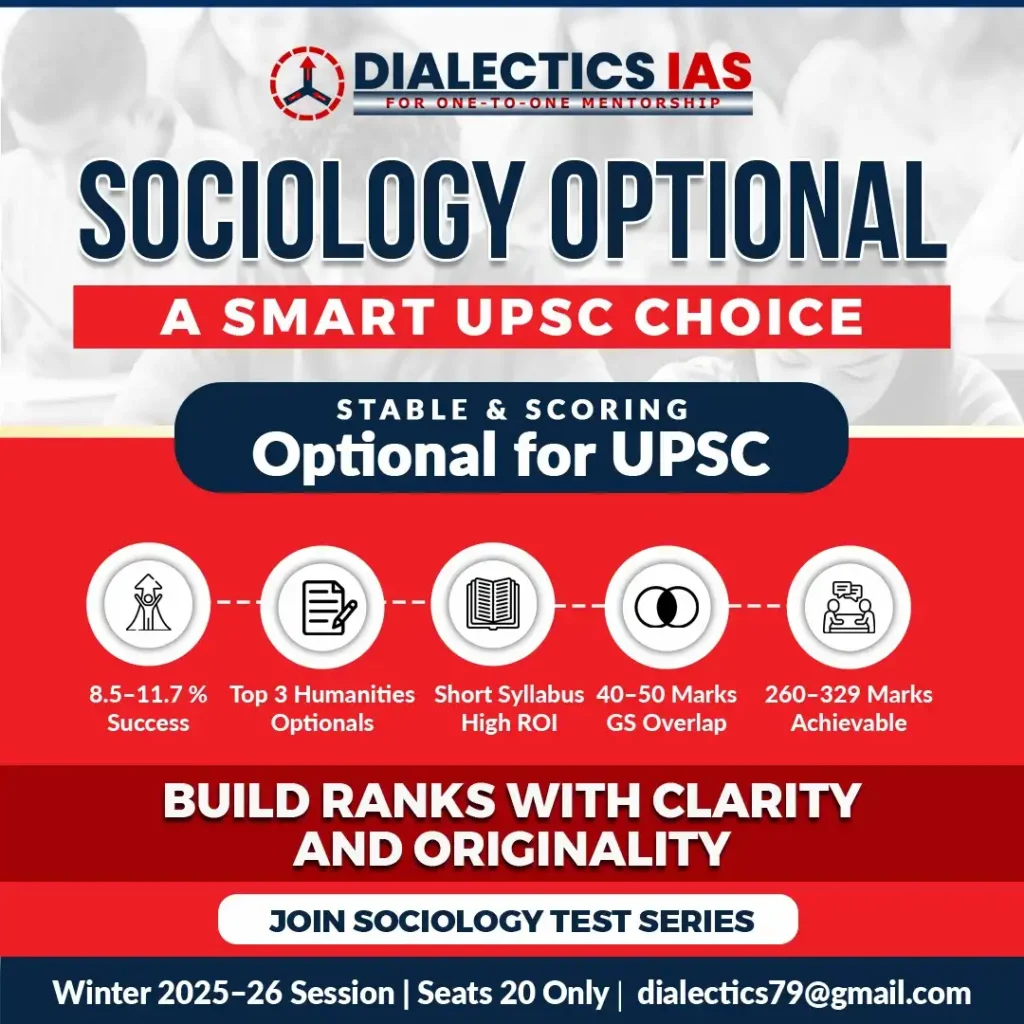
Sociology is one of the most scoring optional subjects in the UPSC IAS exam. Mains returnees who want to score 300+ in sociology optional don’t study more—study smarter and write better. So, you can join an advanced sociology test series for rank improvement 2027.
Here are 6 sociology optional strategies that you can follow to score more in the sociology optional for UPSC Mains exam 2027:
A good sociology optional test series for IAS Mains 2027 is not just about conducting tests—it is about improving answer quality, fixing repeated mistakes, and boosting scores systematically with proper feedback and guidance.
Key Features of an Effective Sociology Optional Test Series for 2027:
Sociology answer-writing practice for UPSC repeat candidates plays an important role in improving answer-writing skills and a score gap between an average (around 230–240 marks) and a high (280–300+ marks) performance.

Get a personalised strategy session to improve your Sociology optional through a 1-to-1 call where our faculty reviews your current level and guides you on exactly what to work on next. Limited to 20 students only.
Dialectics IAS provides online and offline sociology optional test series 2027 for UPSC for re-attempt candidates who want to improve rank or fail in sociology optional in the IAS mains exam. The advanced sociology optional test series for the civil service exam is designed specifically to turn your old mistakes into higher scores or score improvement.
The Sociology Optional Test Series for UPSC Mains at Dialectics IAS offers:
For UPSC Mains returnees, sociology optional success is not about studying more—it’s about writing better answers. A targeted sociology optional test series for Mains re-attempt candidates helps identify past mistakes, refine strategy, boost preparation, and improve overall scores and rank.
Enroll in our Sociology Optional Test Series to get disciplined practice, detailed evaluation, and a clear improvement path for higher scores.
A targeted sociology optional test series reveals scoring gaps through systematic evaluation of your answer structure, sociological depth, and presentation quality. When professors evaluate your copies, they identify repeated patterns—generic conclusions, weak examples, or incorrect use of thinkers—that you might miss during self-practice.
At Dialectics IAS, every answer is checked by professors who compare your performance across sectional and full-length tests. This helps pinpoint whether your weakness lies in Paper 1 theory application or Paper 2 current linkage. Through one-to-one mentorship, you receive a clear improvement plan showing exactly where marks are being lost and how to fix those areas systematically before your next UPSC Mains attempt.
Most sociology optional mains returnees unknowingly repeat five critical mistakes that cap their scores:
A sociology mains test series with professor evaluation helps you identify which of these mistakes you're making and provides a structured plan to correct them before the next attempt.
Effective use of thinkers means applying their concepts to the question demand, not just listing names. For example, instead of writing "Durkheim talked about mechanical and organic solidarity," explain how these concepts relate to the question about Indian urbanization or social change.
Case studies work best when recent and relevant—use specific movements (Narmada Bachao Andolan), policies (National Education Policy), or current issues (gig economy workers) to strengthen your sociological arguments.
Diagrams and flowcharts should clarify relationships, not decorate answers. A simple flowchart showing Marx's base-superstructure model or a diagram of India's caste mobility patterns improves presentation and saves writing time. Weekly sociology optional answer writing practice with feedback helps you develop this skill naturally.
Weekly practice rebuilds writing discipline and sharpens question interpretation skills that often weaken after an unsuccessful Mains attempt. When you write consistently and receive a professor's evaluation, you start noticing patterns in your mistakes—whether you're writing generic introductions, weak conclusions, or missing the question's demand.
Regular evaluation prevents you from practicing the wrong approach repeatedly. Instead of writing 50 average answers, you write 10–15 answers, receive detailed feedback, understand corrections, and rewrite improved versions. This cycle of write-evaluate-correct-rewrite is what actually improves marks, not just increasing the number of practice answers without proper guidance from a structured sociology optional test series.
Moving from 230–240 to 300+ requires improving answer quality, not just syllabus knowledge. Focus on these six areas:
Area | Improvement Strategy |
|---|---|
Answer structure | Use a clear introduction, body, and conclusion with subheadings |
Sociological depth | Move from definition-based to analytical answers |
Question demand | Spend 2–3 minutes understanding what is actually being asked |
Examples & data | Add recent case studies, movements, and current affairs naturally |
Presentation | Use diagrams, flowcharts, and proper spacing |
Time management | Complete all questions; avoid perfectionism |
Joining a sociology optional test series with live feedback helps you systematically work on each area through evaluated practice and personalized mentorship rather than trial-and-error improvement.
Yes, weekly practice is necessary because it rebuilds the writing consistency and exam temperament that weakens after a failed Mains attempt. Many mains returnees know the syllabus well but struggle with answer structure, time management, and sociological presentation—problems that only regular evaluated writing can fix.
Weekly sociology answer writing practice helps you move from theory recall to analytical expression. When you write one answer weekly and receive professor feedback, you learn to decode question demand properly, use thinkers correctly, and improve presentation naturally. This consistent rhythm prevents the common mistake of reading theory endlessly without actually improving answer quality, which is what determines your marks in UPSC Mains.
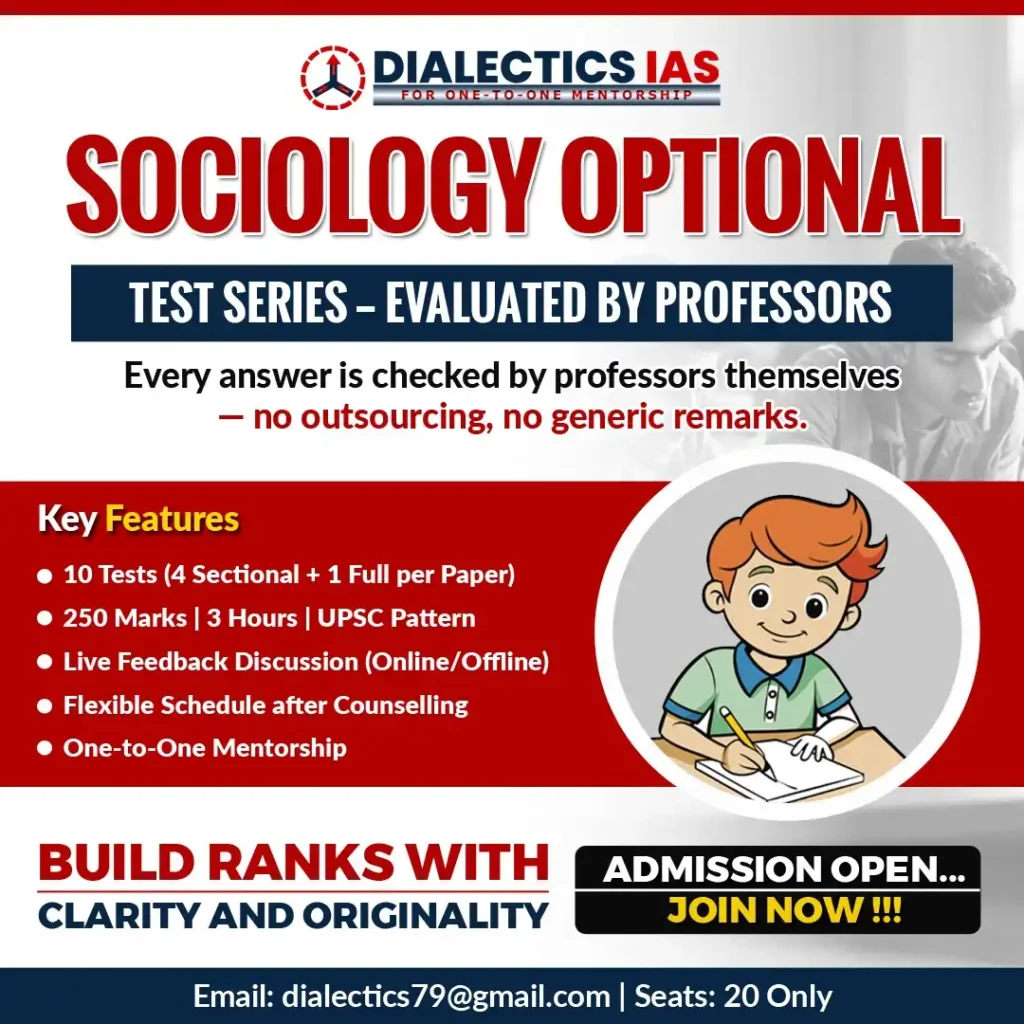
Dialectics IAS follows a counselling-first admission process for the sociology optional test series 2027. You begin by emailing dialectics79@gmail.com to request a counselling session with professors. This one-to-one discussion helps professors understand your previous Mains performance, current preparation level, and specific weaknesses in answer writing.
Based on this counselling, professors suggest whether you should join the Standard (for structured practice) or Premium (for intensive mentorship with answer rewriting support) test series. Seats are limited to 20 only to maintain academic attention. The institute is based in Old Rajinder Nagar, with online and offline discussion options available for Delhi-based aspirants preparing near Karol Bagh or Patel Nagar.
Yes, weekly practice directly improves exam time management by helping you develop answer-writing speed, word discipline, and question-selection judgment. When you write answers regularly under word limits, you naturally learn how much content fits in 200 or 250 words and how long each section should take.
Sociology answer writing evaluation reveals if you're spending too much time on introduction, writing unnecessarily long conclusions, or getting stuck on difficult questions. Through repeated practice and feedback, you develop the ability to quickly decode question demand, mentally structure your answer, and write at the pace needed to complete both Paper 1 and Paper 2 within the three-hour limit without compromising quality.
One-to-one mentorship provides personalized diagnosis of your specific weaknesses—something generic written remarks cannot achieve. When a professor discusses your evaluated copy directly, they explain not just what is wrong but why it happened and how to correct it through your next answer.
For example, if you consistently write generic conclusions, the professor shows you how to make them more sociological and analytical. If you misread question demand repeatedly, they help you develop a method to decode directives like "critically examine," "discuss," or "evaluate." This focused attention helps mains returnees break old patterns faster because the guidance addresses your individual mistakes rather than giving standardized feedback that applies to everyone.
Yes, poor presentation and handwriting significantly affect your sociology optional marks because UPSC evaluators assess hundreds of answer sheets under time pressure. If your answers have long paragraphs without subheadings, no diagrams or flowcharts, and unclear handwriting, the evaluator struggles to identify your key points and sociological depth.
A good presentation means using proper spacing, clear subheadings, bullet points for listing, and diagrams where appropriate. Even if your content is strong, a weak presentation makes it harder for evaluators to appreciate your understanding, leading to lower marks. A sociology mains test series with professor feedback helps you improve presentation systematically by showing exactly how your answer appears to an evaluator and what changes would improve readability and impact.
For sociology optional mains returnees, one-to-one mentorship bridges the gap between knowing the syllabus and writing answers that earn 280–300+ marks. Repeat candidates don't need more theory—they need personalized guidance on why their answers aren't translating into higher scores despite preparation.
Through individual discussions, professors identify if your issue is:
Instead of written remarks that feel impersonal, live feedback discussions help you understand corrections in your own context. For working professionals or self-study aspirants, this mentorship provides the academic clarity and confidence needed to approach the next Mains attempt with a refined strategy rather than repeating the same preparation pattern.
The Dialectics IAS sociology optional test series is designed specifically for re-attempt candidates through professor-only evaluation, personalized mentorship, and systematic mistake correction. Unlike generic test series, it focuses on fixing the specific weaknesses that caused low scores in your previous Mains attempt.
The test series includes:
With limited seats (20 only), professors give focused attention to each candidate's improvement journey, helping you move from average scores (230–240) toward higher performance (280–300+) through structured, evaluated practice.
Yes, Dialectics IAS offers a flexible and personalized test schedule designed specifically for working professionals and candidates managing limited preparation time. Unlike fixed-calendar test series, the schedule is finalized only after your counselling session, based on your work commitments and preparation stage.
This flexibility allows you to:
The online sociology optional test series format means you can submit handwritten answers via email and receive evaluated copies with detailed feedback. For Delhi-based aspirants near Karol Bagh or Mukherjee Nagar, offline discussion sessions are also available for deeper mentorship when needed.
Written by:

Published on:
February 13, 2026
Category:
If you’re unsure where to begin, write to us. Our professors personally guide each aspirant after a short counselling session.
A detailed guide to the most reliable Sociology Optional books, notes, and practice resources for UPSC CSE. This post explains which books to read, when to read them, and how to use each resource across different stages of preparation — basics, answer writing, revision, and test practice.
Dialectics IASNovember 16, 20260 comment Facebook X-twitter Youtube Table of Contents You have saved four booklists. One came from a topper's video, one from...
Dialectics IASNovember 15, 20260 comment Facebook X-twitter Youtube Table of Contents You have written eight tests. Each one came back with a number, a...
Dialectics IASSeptember 23, 20260 comment Facebook X-twitter Youtube Table of Contents Most Sociology Optional aspirants do not struggle because they read too little. They...
