Best Sociology Optional Test Series for UPSC Mains 2027

Are you preparing for UPSC mains with sociology optional and looking for a structured sociology optional test series to improve your score through personal feedback and clear evaluation? Dialectics IAS sociology online test series offers exactly that.

Book a free counselling

Sociology Optional Test Series by Dialectics IAS

Dialectics IAS brings the best sociology optional mains test series for aspirants who want real improvement after completing the syllabus. This Sociology Optional Online Test Series with personal evaluation focuses on improving your answer quality and structure. Each test is checked only by professors, ensuring honest assessment and relevant feedback instead of generic remarks.


This UPSC sociology optional test series online is personalised and flexible, based on counselling and individual needs. With one-to-one mentorship and feedback with a clear improvement plan, the “sociology optional mains test series” by Dialectics IAS helps you correct mistakes, gain clarity, and ultimately increase your marks.

DateTest No.DescriptionSyllabus
15 Nov. 2026Test 1Paper I – Sectional Test 1*Sociology – The Discipline *Sociology as Science *Research Methods and Analysis *Sociological Thinkers *Stratification and Mobility
29 Nov. 2026Test 2Paper I – Sectional Test 2*Works and Economic Life *Politics and Society *Religion and Society *System of Kinship *Social Change in Modern Society
13 Dec. 2026Test 3Paper II – Sectional Test 1*(A) Introducing Indian Society *(B) Social Structure
27 Dec. 2026Test 4Paper II – Sectional Test 2*(C) Social Changes in India
10 Jan. 2027Test 5Paper I – Complete SyllabusPaper I – Complete Syllabus
24 Jan. 2027Test 6Paper II – Complete SyllabusPaper II – Complete Syllabus
Achievement

Results That Speak For Themselves

Marks like 305, 303, 280, 270, 290, 279, 272, 264, 265 don't come from luck — they come from daily writing practice, strong conceptual clarity, and personal mentorship.

Chandramohan Garg

Rank: 25
Year: 2015-16

Aparna Gupta

Rank: 38
Year: 2017-18
Marks: 303

Syeed Fakhrudin Hamid

Rank: 86
Year: 2016-17

Benson S Ninan

Rank: 90
Year: 2017-18
Marks: 305

Apurv Chauhan

Rank: 148
Year: 2017-18
Marks: 270

Ankit Yadav

Rank: 191
Year: 2017-18
Marks: 280

Sumit Kumar Singh

Rank: 229
Year: 2020-21

Sonia Nain

Rank: 244
Year: 2015-16

Harsh Singh

Rank: 244
Year: 2017-18
Marks: 290

Arun Balgotra

Rank: 280
Year: 2020-21
Marks: 271

Vivek Rathee

Rank: 390
Year: 2015 -16

Apurv Chauhan

Rank: 438
Year: 2016-17

Abhijeet Yadav

Rank: 653
Year: 2017-18
Marks: 279

Shilpa Bhatti

Rank: 712
Year: 2017-18
Marks: 264

K. Subhash

Rank: 825
Year: 2022-23
Marks: 272

W. Aotula Ozukum

Rank: 874
Year: 2022-23
Marks: 265
And many more… 1500+ selections including IAS, IFS & IPS

Sociology Optional Online Test Series for UPSC Mains

Questions papers for Civil Services Examination by generally set and evaluated by senior professors of the respective discipline. At Dialectics IAS, civil services aspirants with Sociology optional get a chance to interact directly with senior professors for effective feedback.


We believe in encouraging original thinking among candidates and, therefore, we don’t believe in providing standard model answers to each and every question. At an examination of UPSC level, such standard model answers may do more harm than good to the candidates. However, each question is discussed in detail and special emphasis is laid on the Line of Argument in the answer.


UPSC looks for originality, spontaneity and creativity. Our test series is aimed just for that. However, to guide candidates, some model answers would be shared from time to time. We also wouldn’t be uploading the answer-scripts of toppers for the same reason. We aim to highlight and encourage individual differences among candidates, not level them.


Important:

We don’t outsource evaluation of answer scripts of candidates. At Dialectics IAS, evaluation is done by professors only. Admission, however, is subject to the availability of slot with the respective professor.


Our Sociology Online Test Series is Personalized and Flexible as per the assessment of the candidate after the counselling. We are dedicated for qualitative One-To-One Mentorship. Due to very limited seats, we invite only serious, very serious civil services aspirants. 


Total Tests: 6 (2 Sectional Tests Each for Paper I & II; 1 Full-Length Test Each for Paper I & II); Each Test of 250 Marks; Duration: 3 hours)

Total Seats: 20
Fee: Rs. 9,000 (Candidates must complete all Tests within a year of registration)

Discount for economically needy candidates

Boost Your Sociology Optional Marks Before UPSC Mains (LAST CHANCE)

Get professor evaluated tests, personal feedback, and one to one guidance designed to fix mistakes, sharpen answers, and help you score higher in mains with a clear improvement plan.

Male teacher writing on board in realistic classroom.
Have Questions Before Joining Test Series?

Write to us for fee details, counselling queries, or eligibility clarification. Our team will guide you honestly and help you decide the right test series based on your preparation stage.

Welcome to Dialectics IAS

A Serious Platform to Help Students with focused Sociology Optional Preparation

Dialectics IAS is known for its focused approach to sociology optional preparation. Our system is designed for aspirants who want a  sociology optional test series to improve marks through honest evaluation and academic clarity.


We offer a sociology optional test series with professor feedback where every answer is checked personally. With limited seats, one to one mentorship, and structured improvement plans, students receive the guidance needed to perform better in UPSC mains.

Why Students Trust Dialectics IAS

Why Choose Dialectics IAS for Sociology Online Test Series

Choosing the right sociology mains test series is critical for improving answer quality and final marks. Dialectics IAS offers an online sociology optional test series focused on evaluation depth, personal mentorship, and structured improvement. It is trusted by serious aspirants as one of the “best sociology test series for IAS” due to its academic honesty and professor-led approach.

Professor Led Evaluation

Every answer is checked by experienced professors, ensuring conceptual clarity, sociological depth, and relevant guidance aligned strictly with UPSC sociology mains expectations.

Personalised Feedback System

Each student receives individual feedback, clear correction points, and a practical improvement plan designed around personal weaknesses and strengths.

Flexible Online Test Structure

This sociology optional online mock test series allows flexible scheduling, making it suitable for working professionals and full-time aspirants.

Focus on Marks Enhancement

The sociology optional mock test series emphasises answer presentation, structure, and analytical depth to help aspirants consistently score higher in mains.

books, plants, and charts visible, balanced

Who Should Join Sociology Test Series for UPSC Mains 2027

This is the best sociology optional online test series for aspirants who want focused practice and honest evaluation. It suits beginners needing direction, working professionals managing limited time, and serious candidates aiming to improve sociology optional mains performance with structured guidance.

Key Features of Test Series for Sociology Optional

This interactive online sociology optional test series is built to strengthen answer writing and conceptual clarity. With focused UPSC sociology answer writing practice, aspirants receive the right environment to improve structure, depth, and marks consistently.

Why Choose Sociology Optional for UPSC Mains

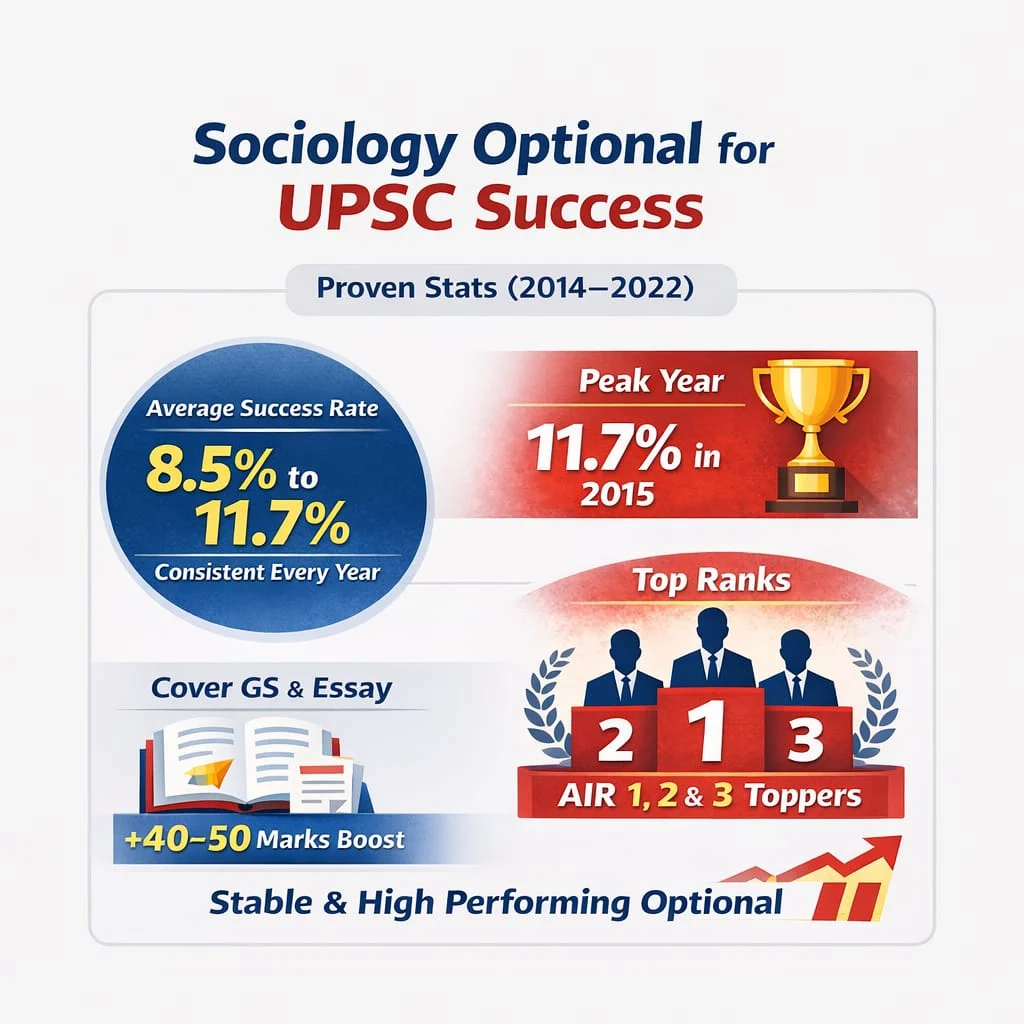
Sociology has consistently remained a high scoring optional in UPSC mains. Official UPSC data from 2014 to 2022 shows stable success rates between 8.5 to 11.7 percent. Even as competition increased, sociology continued to deliver results. It also overlaps with the GS syllabus, and the essay also adds a strategic advantage for serious aspirants.

Sociology Optional Test for UPSC Success
Talk to a Sociology Mentor
Clarify your optional strategy, test readiness, and writing gaps through direct interaction with experienced professors before you begin the test series.

UPSC Sociology Optional Syllabus Overview

Before starting preparation, it is important to clearly understand the official sociology optional syllabus. A well-defined syllabus helps you plan answer writing, revision, and test practice in a structured way for the UPSC mains. So let’s have a look at the official syllabus of sociology optional below.

PAPER-I: FUNDAMENTALS OF SOCIOLOGY
  • Modernity and social changes in Europe and emergence of sociology
  • Scope of the subject and comparison with other social sciences
  • Sociology and common sense
  • Science, scientific method and critique
  • Major theoretical strands of research methodology
  • Positivism and its critique
  • Fact, value and objectivity
  • Non-positivist methodologies
  • Qualitative and quantitative methods
  • Techniques of data collection
  • Variables, sampling, hypothesis, reliability and validity
  • Karl Marx – Historical materialism, mode of production, alienation,
  • class struggle
  • Emile Durkheim – Division of labour, social fact, suicide, religion and society
  • Max Weber – Social action, ideal types, authority, bureaucracy, protestant ethic and the spirit of capitalism
  • Talcott Parsons – Social system, pattern variables
  • Robert K. Merton – Latent and manifest functions, conformity and deviance, reference groups
  • Mead – Self and identity
  • Concepts – equality, inequality, hierarchy, exclusion, poverty and deprivation
  • Theories of social stratification – structural functionalist theory, Marxist theory, Weberian theory
  • Dimensions – social stratification of class, status groups, gender, ethnicity and race
  • Social mobility – open and closed systems, types of mobility, sources and causes of mobility
  • Social organization of work in different types of society – slave society, feudal society, industrial/capitalist society
  • Formal and informal organization of work
  • Labour and society
  • Sociological theories of power
  • Power elite, bureaucracy, pressure groups and political parties
  • Nation, state, citizenship, democracy, civil society, ideology
  • Protest, agitation, social movements, collective, action, revolution
  • Sociological theories of religion
  • Types of religious practices: animism, monism, pluralism, sects, cults
  • Religion in modern society: religion and science, secularization, religious revivalism, fundamentalism
  • Family, household, marriage
  • Types and forms of family
  • Lineage and descent
  • Patriarchy and sexual division of labour
  • Contemporary trends
  • Sociological theories of social change
  • Development and dependency
  • Agents of social change
  • Education and social change
  • Science, technology ad social change
PAPER – II: INDIAN SOCIETY: STRUCTURE AND CHANGE

(i) Perspectives on the study of Indian society:

  • Indology (G S Ghurye)
  • Structural functionalism (M N Srinivas)
  • Marxist sociology (A R Desai)

(ii) Impact of colonial rule on Indian society:

  • Social background of Indian nationalism
  • Modernization of Indian tradition
  • Protests and movements during the colonial period
  • Social reforms

(i) Rural and Agrarian Social Structure:

  • The idea of Indian village and village studies
  • Agrarian social structure – evolution of land tenure system, land reforms

(ii) Caste System:

  • Perspectives on the study of caste system:GS Ghurye, M N Srinivas, Louis Dumont, Andre Beteille
  • Feature of caste system
  • Untouchability – forms and perspectives

(iii) Tribal communities in India:

  • Definitional problems
  • Geographical spread
  • Colonial policies and tribes
  • Issues of integration and autonomy

(iv) Social Classes in India:

  • Agrarian class structure
  • Industrial class structure
  • Middle classes in India

(v) Systems of Kinship in India:

  • Lineage and descent in India
  • Types of kinship systems
  • Family and marriage in India
  • Household dimensions of the family
  • Patriarchy, entitlements and sexual division of labour

(vi) Religion and Society:

  • Religious communities in India
  • Problems of religious minorities

(i) Visions of Social Changes in India:

  • Idea of development planning and mixed economy
  • Constitution, law and social change
  • Education and social change

(ii) Rural and Agrarian transformation in India.

  • Programmes of rural development, Community Development
  • Programme, cooperatives, poverty alleviation schemes
  • Green revolution and social change
  • Changing modes of production in Indian agriculture
  • Problems of rural labour, bondage, migration

(iii) Industrialization and Urbanisation in India:

  • Evolution of modern industry in India
  • Growth of urban settlements in India
  • Working class: structure, growth, class mobilization
  • Informal sector, child labour
  • Slums and deprivation in urban areas

(iv) Politics and Society:

  • Nation, democracy and citizenship
  • Political parties, pressure groups social and political elite
  • Regionalism and decentralization of power.
  • Secularization

(v) Social Movements in Modern India:

  • Peasants and farmers movements
  • Women’s movement
  • Backward classes & Dalit movement
  • Environmental movements
  • Ethnicity and identity movements

(vi) Population Dynamics:

  • Population size, growth, composition and distribution
  • Components of population growth: birth, death, migration
  • Population policy and family planning
  • Emerging issues: ageing, sex ratios, child and infant mortality, reproductive health

(vii) Challenges of Social Transformation:

  • Crisis of development displacement, environmental problems and sustainability
  • Poverty deprivation and inequalities
  • Violence against women
  • Caste conflicts
  • Ethnic conflicts, communalism, religious revivalism
  • Illiteracy and disparities in education

What Students Say About Dialectics IAS

Real experiences from sociology optional aspirants who got mentorship from professors, received honest evaluation, and improved their mains answers through structured feedback and mentorship.

I came across Dialectics while searching for top online sociology test series after finishing my syllabus. Earlier, I was writing answers, but my marks were not improving. After joining, the feedback clearly showed issues in structure and relevance.

Animesh Sharma

I found Dialectics while looking for a sociology optional test series with professor feedback. Before this, I never knew if my answers were right or wrong. The feedback sessions helped me understand how to balance theory and examples properly.

Neha Purohit

I was comparing different sociology test series for UPSC and found Dialectics through online reviews. Earlier, I wrote many tests, but nothing changed. Here, professors explained mistakes patiently and asked me to rewrite answers, which really improved clarity.

Rohit Patel

I discovered Dialectics through a Telegram discussion on the sociology optional test series. Being a working professional, I needed flexibility. The test schedule and feedback discussions were adjusted accordingly, and the guidance always felt personal and serious.

Pooja Singh

I came to know about Dialectics while searching for professor evaluated sociology test series online. Earlier feedback from other places felt generic. Here, comments were detailed and honest, which helped me improve answer presentation and sociological depth.

Kunal Kushwaha

I found Dialectics when searching for a sociology optional test series with proper evaluation. Paper Two was my weak area. After joining, feedback helped me understand how to use thinkers and examples more effectively in answers.

Anjali Yadav

After writing mains once, I searched for a serious sociology optional test series online. Dialectics stood out due to the professor's involvement. The premium feedback helped me see exactly where I was losing marks and how to fix it.

Saurabh Gupta

Join the Next Sociology Batch

Start your Sociology Optional test journey with a batch designed for serious aspirants who value clarity, originality, and professor-guided improvement.

Frequently Asked Questions

Read Sociology Optional Preparation Related Resources & Articles

Explore helpful blogs, insights, and strategy articles related to sociology optional preparation. These posts cover answer writing ideas, test series guidance, and UPSC mains strategies to support your sociology optional journey.

Sociology Optional Test Series Enquiry

Not sure which sociology optional test series fits your preparation stage? Share your details to get clear information on the test structure, evaluation process, and admission requirements for UPSC mains.

Take the First Step—We will Guide You
Chat Now Enquire Now
Dialectics IAS Long Logo
Admission Open
Online Test Series: Mains 2027
Starts on 15 Nov. 2026