

UPSC Mains 2026 Sociology Optional Paper Analysis: What It Means for Your 2027 Preparation
Dialectics IASSeptember 16, 20260 comment Facebook X-twitter Youtube Table of Contents If you sat for UPSC Mains 2026 as a repeater, or you are...
For many sincere UPSC aspirants, Sociology Optional becomes the natural choice. It connects well with General Studies and everyday social realities. But scoring well in Sociology Optional is not about collecting notes or memorising model answers. It is about understanding what the UPSC evaluator actually looks for and practising in a disciplined, exam-oriented way.
At Dialectics IAS, we see Sociology Optional PYQ UPSC papers as the clearest window into that evaluator’s mind. This page brings together UPSC Sociology Optional Previous Year Question Papers (2010–2024) in PDF format, along with calm, professor-style guidance on how to use these Sociology Optional PYQs for structured answer writing.
Our aim is simple: help you use Sociology Optional PYQ UPSC not as a shortcut, but as a map to build clarity, depth, and originality in your answers.
This page is designed as a quiet study space for serious UPSC Sociology aspirants. Here, you will find:
Every week, one question is posted under “Let’s Practice.” You can attempt it and get your answer evaluated by professors.
Below is a simple, year-wise list of UPSC Sociology Optional Question Papers. These Sociology Optional Previous Year Question Papers PDF are organised for easy access and practice.
Year | Sociology Optional Paper 1 PDF | Sociology Optional Paper 2 PDF |
2024 | Download PDF (Paper 1) | Download PDF (Paper 2) |
2023 | Download PDF (Paper 1) | Download PDF (Paper 2) |
2022 | Download PDF (Paper 1) | Download PDF (Paper 2) |
2021 | Download PDF (Paper 1) | Download PDF (Paper 2) |
2020 | Download PDF (Paper 1) | Download PDF (Paper 2) |
2019 | Download PDF (Paper 1) | Download PDF (Paper 2) |
2018 | Download PDF (Paper 1) | Download PDF (Paper 2) |
2017 | Download PDF (Paper 1) | Download PDF (Paper 2) |
2016 | Download PDF (Paper 1) | Download PDF (Paper 2) |
2015 | Download PDF (Paper 1) | Download PDF (Paper 2) |
2014 | Download PDF (Paper 1) | Download PDF (Paper 2) |
2013 | Download PDF (Paper 1) | Download PDF (Paper 2) |
2012 | Download PDF (Paper 1) | Download PDF (Paper 2) |
2011 | Download PDF (Paper 1) | Download PDF (Paper 2) |
2010 | Download PDF (Paper 1) | Download PDF (Paper 2) |
You can use these as:

Get a personalised strategy session to improve your Sociology optional through a 1-to-1 call where our faculty reviews your current level and guides you on exactly what to work on next. Limited to 20 students only.
For any optional subject, previous year question papers are not a side resource. They are central to focused preparation. This is especially true for UPSC Sociology Optional Previous Year Questions. PYQs help you in several academic ways:
Sociology Optional PYQs show the real level of clarity, structure, and depth that UPSC expects. They do not rely on guesswork. They reveal what “good” looks like in the eyes of the evaluator.
You learn the exact language used in UPSC Sociology PYQ – whether the question asks for description, comparison, critique, or application. This improves your reading of the paper and reduces confusion in the exam hall.
When you go through Sociology Optional Previous Year Questions, you start seeing repeating themes: classical thinkers, caste, gender, social movements, stratification, Indian social change, and so on. This helps you focus on truly important areas instead of spreading yourself thin.
Sociology Optional PYQ UPSC often asks you to connect Paper 1 theories (Marx, Weber, Durkheim, research methods) with Paper 2 issues (caste, social movements, development, social policy). Regular PYQ practice trains you to make these links naturally.
At Dialectics IAS, we treat UPSC Sociology Optional PYQ as the starting point for answer-writing discipline. Writing answers to real questions under a time limit builds speed, confidence, and structured thinking.
In this sense, PYQs act like a quality control tool. They keep your Sociology Optional preparation aligned with what the UPSC actually tests, not just with what material is available.
Sociology Optional carries 500 marks in the UPSC Mains examination. It is divided into:
Each paper is 3 hours. Both are descriptive. In both papers, you have to attempt five questions. Questions 1 and 5 are compulsory. You then choose three more questions, with at least one from each section (A and B). A clear understanding of this structure is essential before you start using Sociology Optional PYQ UPSC for practice.
Paper 1 vs Paper 2 – Core Academic Difference
Paper | Focus | Core Content Areas | UPSC Demand |
Paper 1 | Fundamentals of Sociology | Sociological thinkers, theories, concepts, research methods, social institutions | Conceptual depth, theoretical clarity, analytical links |
Paper 2 | Indian Society: Structure & Change | Application of theory to India, structure, change, social problems, movements | Application, current affairs linkage, Indian examples |
Paper 1 is relatively more static and theory-centric.
Paper 2 is dynamic, rooted in contemporary Indian society.
Analysing Sociology Optional Previous Year Question Papers helps you see how UPSC uses the syllabus:
In Paper 1,
PYQs show that no major unit can be ignored. Units on thinkers, methods, stratification, work, and social change appear regularly in some form. Often, questions demand synthesis – for example, linking a theoretical concept to a contemporary issue.
In Paper 2,
PYQs show the clear expectation of bridging theory and current affairs. Questions on caste, tribe, kinship, population, social movements, and social transformation frequently draw from recent developments, policies, and debates.
At Dialectics IAS, we advise aspirants to read the Sociology Optional syllabus with UPSC Sociology Optional Previous Year Questions side-by-side. This builds a strong mental map between units and the way they are actually tested in the exam.
Enroll in our Sociology Optional Test Series to get disciplined practice, detailed evaluation, and a clear improvement path for higher scores.
Simply solving Sociology Optional PYQ UPSC questions is not enough. Analysing them is equally important. PYQ analysis helps you understand how the paper has evolved, especially in the last few years.
From around 2018 onwards, there is a clear shift:
This means you cannot depend only on selective reading or memorised model answers. You need conceptual clarity, flexibility, and the ability to connect different units.
In Paper 1 – Fundamentals of Sociology, some patterns stand out:
Thinkers remain central:
Marx, Weber, Durkheim, and other classical thinkers continue to feature strongly. Questions demand comparison, critique, and application – not just definition.
Research methods have regained weight:
Issues like positivism vs interpretative approaches, objectivity, value neutrality, sampling, and newer methods (like digital ethnography) appear more frequently in Sociology Optional PYQ UPSC.
Stratification and work:
Units on social stratification and work/economic life often appear in 20-mark questions. They ask you to analyse inequality, class, gender, and changing forms of work (including gig economy) in a deeper way.
In Paper 2 – Indian Society: Structure and Change, three points are clear:
Paper 1–Paper 2 linkage is expected:
You are expected to use theories from Paper 1 to interpret Indian realities. For example, applying theories of bureaucracy, anomie, or social movements to Indian state, caste, or protests.
Static and current affairs are blended:
Questions on caste, tribe, kinship, social movements, population, and development regularly use recent examples, data, and policy debates.
High-yield themes:
Caste, social movements, gender, population issues, social transformation, and development challenges remain high-yield areas across UPSC Sociology Optional Previous Year Questions.
Aspirants who treat PYQ analysis as a serious academic exercise—not just pattern spotting—are better placed to write structured, original, and relevant answers.
Using Sociology Optional PYQ UPSC wisely is a skill in itself. A simple, phased approach can help:
Every week, one question is posted under “Let’s Practice.” You can attempt it and get your answer evaluated by professors. It’s a low-cost way to improve consistency, test your clarity, and experience evaluation quality firsthand at Dialectics IAS.
Many aspirants ask the same questions:
For meaningful Sociology Optional PYQ analysis, looking at 15 years (2010–2024) is helpful. For serious writing practice, focusing on at least the last 10 years of UPSC Sociology Optional Previous Year Questions is a good practical target.
You do not need to wait till the full syllabus is complete. Once you have basic clarity in a unit, you can:
PYQs then guide your reading instead of being a final-stage activity only.
You can treat PYQ practice as a weekly discipline. Write in exam-like conditions, respecting the time and word limit, especially for 10-mark and 20-mark questions.

Start by solving Sociology Optional PYQ UPSC year-wise under time limits, not just reading questions and model answers. Then map each question back to the Sociology Optional syllabus and note which thinkers, concepts, and Indian examples you used. If you want structured guidance on PYQ-based answer writing, Dialectics IAS offers professor-led evaluation and discussion on your UPSC Sociology Optional answers.
For most aspirants, practising the last 10 years of Sociology Optional Previous Year Questions is a good, realistic target. It covers the current UPSC Sociology Optional style and trend of questions. If you have time, you can also scan PYQs from 2010 onwards for extra pattern awareness. At Dialectics IAS, we usually design Sociology Optional PYQ practice around this 10–15 year window.
Exact Sociology Optional PYQs rarely repeat, but core themes and ideas do come back in new forms. You will see recurring focus on thinkers, caste, gender, development, social movements, and Indian social change. This is why we encourage students at Dialectics IAS to learn how to handle themes, not memorise fixed answers to old UPSC Sociology Optional question papers.
PYQ practice is essential, but usually not enough by itself. You also need regular, exam-like writing and objective feedback on your answers. That is where a good Sociology Optional Test Series helps. At Dialectics IAS, PYQs form the backbone of our professor-led Sociology Optional test series, and every copy is discussed one-to-one after evaluation.
A beginner can start using Sociology Optional Previous Year Questions as soon as the basics of a few units are clear. You do not need to finish the full syllabus first.
The sensible approach is: read a unit, then try 2–3 PYQs from that area. At Dialectics IAS, we often use PYQs to guide reading and note-making from an early stage.
Aim for a simple weekly routine: 2–3 Sociology Optional PYQs per day or at least 10–12 questions per week under exam conditions. Always write full answers, not just bullet points in your mind. Many students at Dialectics IAS follow a “PYQ + feedback” cycle through our Let’s Practice format and main Sociology Optional Test Series.
Across UPSC Sociology Optional Previous Year Questions, some areas appear very regularly: classical thinkers, research methods, stratification, work and economic life in Paper 1; caste, social movements, gender, population, and social transformation in Paper 2. We advise aspirants at Dialectics IAS to treat these as anchor topics and then build outward to cover the full syllabus.
Good PYQ analysis means breaking each question into three parts: command word (discuss, analyse, critically examine), main concept or thinker, and required Indian examples. Then plug it back into the Sociology Optional syllabus. This is exactly how professors at Dialectics IAS discuss UPSC Sociology Optional PYQ patterns in counselling and test discussions.
Use each PYQ to create a short topic sheet: definition, 2–3 key thinkers, main arguments, and 2–3 Indian illustrations. Avoid writing full essay-style notes again.
Over time, your Sociology Optional PYQ-based notes will become a compact revision file. Many Dialectics IAS students use these sheets alongside our discussion-based feedback to refine their final answers.
You can download Sociology Optional PYQ UPSC PDFs year-wise from 2010–2024 directly from the Dialectics IAS website and use them for offline practice. These include both Paper 1 and Paper 2 question papers. If you want more than just PDFs, you can request counselling at Dialectics IAS to build a personalised PYQ strategy and answer-writing plan with professors.
Most sincere aspirants already work hard. The real question is whether that effort is aligned with what the UPSC expects from Sociology Optional PYQ UPSC answers.
Dialectics IAS is a professor-led, small-seat initiative focused only on Sociology Optional Test Series, counselling, and weekly practice. Our work is built around a few clear principles:
If you wish to make your PYQ practice more structured and academically grounded:
In this way, your Sociology Optional Previous Year Question Paper practice can move from being just another task to a meaningful step towards writing clear, original, and high-quality Sociology answers for UPSC Mains.
Written by:

Published on:
December 11, 2025
Category:
If you’re unsure where to begin, write to us. Our professors personally guide each aspirant after a short counselling session.

A detailed guide to the most reliable Sociology Optional books, notes, and practice resources for UPSC CSE. This post explains which books to read, when to read them, and how to use each resource across different stages of preparation — basics, answer writing, revision, and test practice.
Dialectics IASSeptember 16, 20260 comment Facebook X-twitter Youtube Table of Contents If you sat for UPSC Mains 2026 as a repeater, or you are...
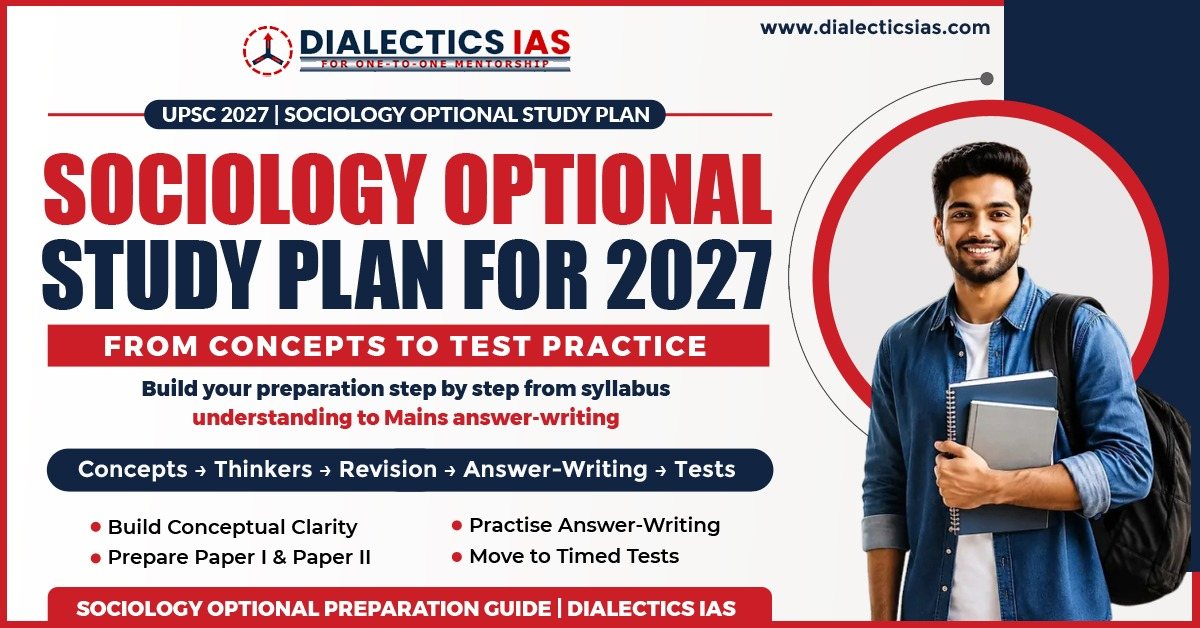
Dialectics IASSeptember 8, 20260 comment Facebook X-twitter Youtube Table of Contents Most Sociology Optional aspirants do not struggle with reading about thinkers. They struggle...
Dialectics IASSeptember 8, 20260 comment Facebook X-twitter Youtube Table of Contents A working professional deciding on Sociology Optional usually pictures the same scene: long...
